Home > Catalogue > by growth >

taller shrub

taller shrub beginning with: complete list

CURRENTLY IN STOCK:

79_1.jpeg
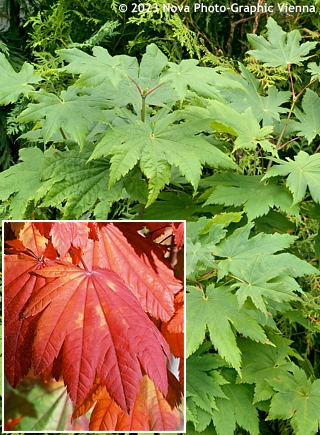
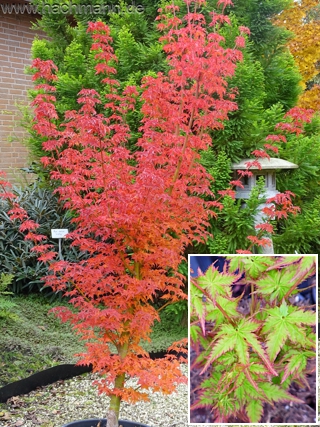
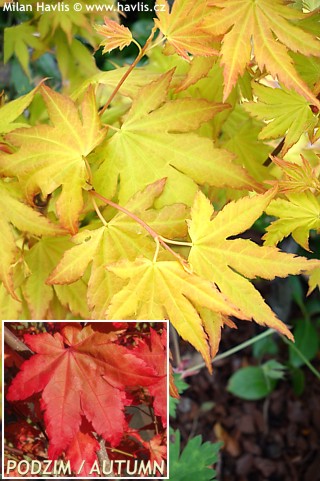
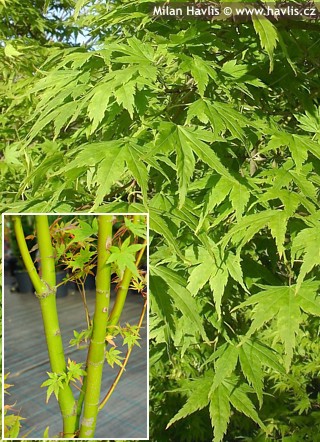
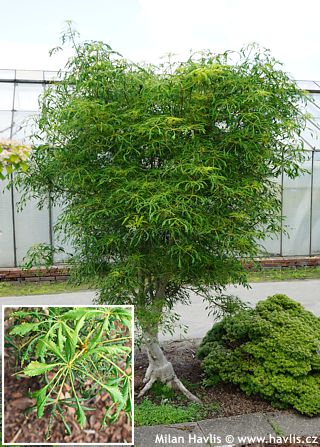
Aconitifolium is a Japanese maple with large leaves. They are very attractive, deeply lobed but look entire. The colour is light to mid green, turning bright shades of orange and fiery red in autumn. In spring it bears profusion of small flowers. The shrub is spreading and even though in Japan you ...
2 - 3m
2 - 3m
full to partial sun
5   (down to -29°C)
Code of winter protection zone 5+6
for zone 5+6
Code of winter protection zone 7
for zone 7
4260_1.jpeg
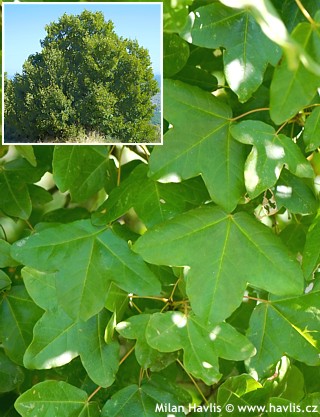
Montpellier maple is a typical Mediterranean tree commonly found in dry, coastal or mountainous landscapes of Portugal, France, and Italy. It makes small, three-lobed, leathery but deciduous leaves, which are medium green in summer, and turn yellow, amber orange or scarlet red in autumn. Its flowers ...
4 - 6m
4 - 6m
full sun
5   (down to -29°C)
Code of winter protection zone 5+6
for zone 5+6
Code of winter protection zone 7
for zone 7
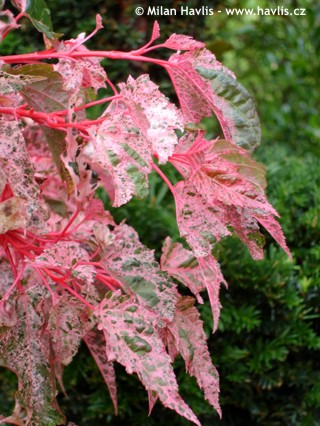
Acer negundo 'FLAMINGO'
Flamingo boxelder has long been a favourite among trees with variegated foliage and is a characteristic product of the garden aesthetics of the late twentieth century, when attention shifted from flower to leaf colour and structure. Its deciduous leaves are attractively marbled with white and pink, ...
5 - 7m
5 - 7m
full sun
2   (down to -45°C)
Code of winter protection zone 5+6
for zone 5+6
Code of winter protection zone 7
for zone 7
505_1.jpeg
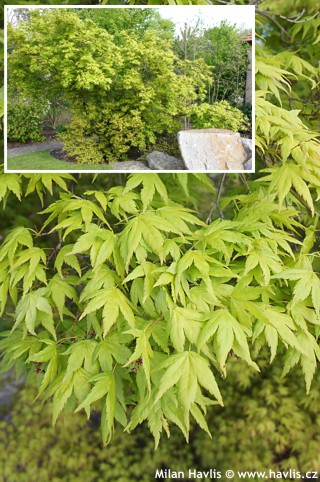
The species of Japanese maple is a green-leaved tree or rather a large shrub. End even though among landscapers and general green-finger-public the red-leaved versions tend to be more popular I suppose that this is the most beautiful and elegant tree of our climate. With its naturally green leaves i ...
3 - 8m
3 - 6m
full to partial sun
5   (down to -29°C)
Code of winter protection zone 5+6
for zone 5+6
Code of winter protection zone 7
for zone 7
504_1.jpeg
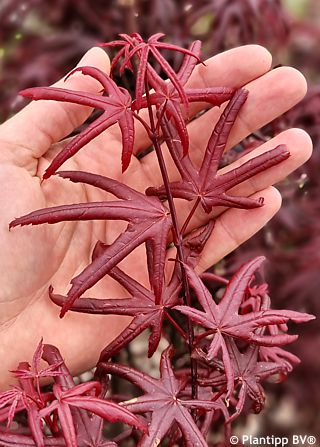
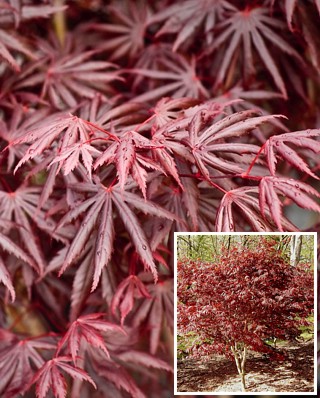
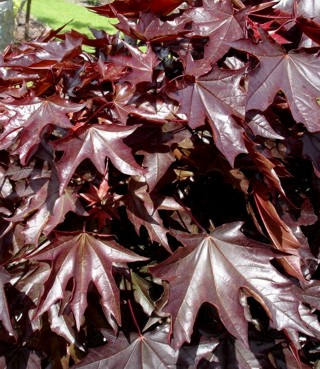
Atropurpureum is a famous and commonly used variety with deeply lobed, red-purple leaves that turn bright red and orange in autumn. They have 5 tips. It forms a multi-stemmed shrub with widely spread branches. It grows slowly and is suitable as a specimen in any garden, not just a Japanese style gar ...
3 - 6m
3 - 4m
full to partial sun
5   (down to -29°C)
Code of winter protection zone 5+6
for zone 5+6
Code of winter protection zone 7
for zone 7
3685_1.jpeg
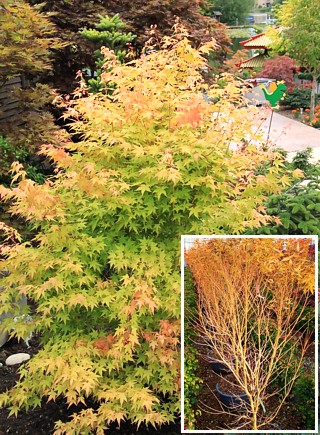
Bi-hoo is a new Japanese maple variety found by maple enthusiast, Mr.Masayoshi, in Japan in 1993. It was introduced and licensed in Europe by Maillot Nurseries in France in 2004. It is valued predominantly for its stunning colour in autumn and winter when the stronger branches and stems gain golden ...
2 - 3m
1,5 - 2m
full to partial sun
5b   (down to -27°C)
Code of winter protection zone 5+6
for zone 5+6
Code of winter protection zone 7
for zone 7
3387_1.jpeg
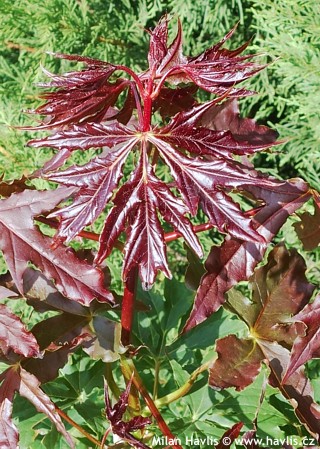
Fireglow is a red-leaved Japanese maple variety from Italy. It is similar to Bloodgood with less vigorous growth and brighter red colour, and Atropurupureum with more upright habit and richer leaf colour. Leaves are palmate, 5-lobed, deciduous, glowing crimson red when they emerge and shiny burgundy ...
2 - 4m
2 - 4m
full sun
5   (down to -29°C)
Code of winter protection zone 5+6
for zone 5+6
Code of winter protection zone 7
for zone 7
1801_1.jpeg
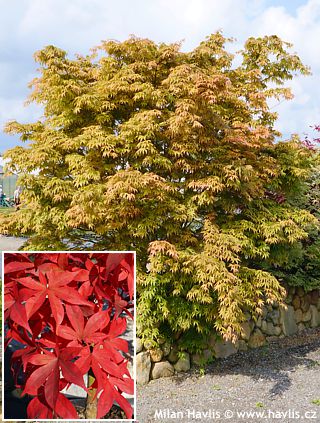
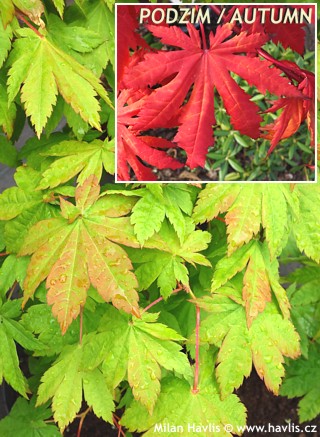
Katsura is a Japanese maple that is highly decorative especially in spring, when new leaves emerge, and in autumn, when they change again. They are typically palmate, rather small, 5-lobed, chartreuse yellow-green with coppery margins in early spring, rich green in summer, and glowing golden-yellow ...
1,5 - 3m
1,5 - 3m
full to partial sun
5   (down to -29°C)
Code of winter protection zone 5+6
for zone 5+6
Code of winter protection zone 7
for zone 7
5449_1.jpeg
The variety name of Osakazuki Japanese maple seems to refer to the third largest city in Japan, Osaka, which is renowned for its extensive vineyards that replaced cotton fields. There could be at least two reasons for choosing it – either in reference to its bright carmine red autumn leaves which co ...
3 - 7m
3 - 5m
full to partial sun
5   (down to -29°C)
Code of winter protection zone 5+6
for zone 5+6
Code of winter protection zone 7
for zone 7
5844_1.jpeg
Red Emperor is another red-leaved Japanese maple, this time from the USA, where it was introduced in 1976 by Dick Wolff from Red Maple Nursery in Pennsylvania. He was an enthusiastic lover of the vibrant shades of red and maroon leaves on Japanese maples, and he was especially proud of his Red Emper ...
4 - 6m
2 - 4m
full to partial sun
5   (down to -29°C)
Code of winter protection zone 5+6
for zone 5+6
Code of winter protection zone 7
for zone 7
5432_1.jpeg
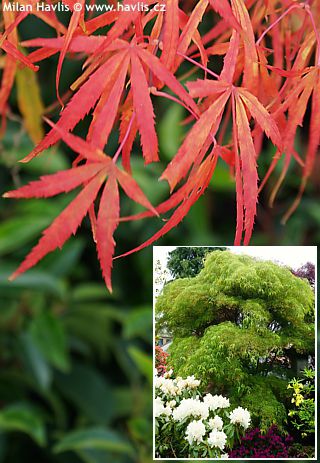
Seiryu is a Japanese maple variety from the dissectum group. Its delicate leaves are deeply cut like a lace, deciduous, they emerge yellow to lime green with red tips in spring, mature to soft green in summer, and turn fantastic shades of gold, orange and red in autumn. It grows rather fast into a w ...
3 - 5m
3 - 4m
full to partial sun
5   (down to -29°C)
Code of winter protection zone 5+6
for zone 5+6
Code of winter protection zone 7
for zone 7
3309_1.jpeg
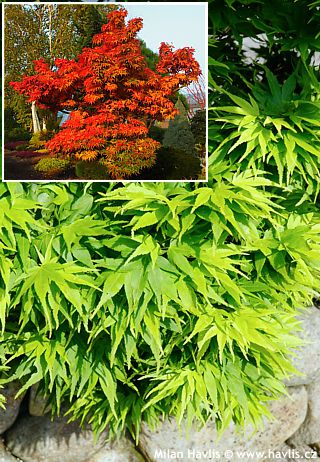
Summer Gold is a special Japanese maple with yellow-green foliage that is very resistant to heat and sun, and is commonly grown in locations where yellow and green coloured maples fail to perform. The leaves are 5 or 7-lobed, palmate, bright golden or almost orange yellow with some salmon orange-pin ...
2 - 3m
2 - 3,5m
full to partial sun
5b   (down to -27°C)
Code of winter protection zone 5+6
for zone 5+6
Code of winter protection zone 7
for zone 7
4482_1.jpeg
Shirasawan’s maple is a sought-after species of Japanese maple valued mostly for its unique leaf shape. To date (July 2020) there are 17 recognized varieties, and MOONRISE is a recent introduction from the USA where its inventor Carl A. Munn patented it as PP16718 in 2004. He discovered it in ...
IV - V
3 - 5m
2 - 4m
full to partial sun
5   (down to -29°C)
Code of winter protection zone 5+6
for zone 5+6
Code of winter protection zone 7
for zone 7
705_1.jpeg
Even among a hundred trees you will notice Red Flamingo hybrid snake-bark maple first. Such a colourful small tree must have been brought directly from Mars where red is constantly in vogue. It is a stunning variety making a breathtaking display wherever you put it. Its key features are the leaves a ...
2 - 4m
1,5 - 3m
full to partial sun
6   (down to -23°C)
Code of winter protection zone 5+6
for zone 5+6
Code of winter protection zone 7
for zone 7
3428_1.jpeg
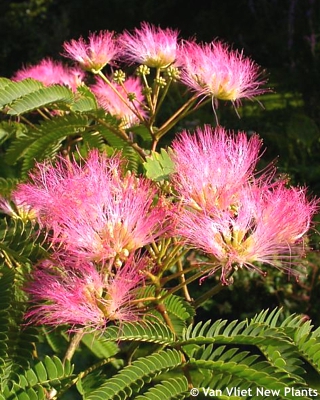
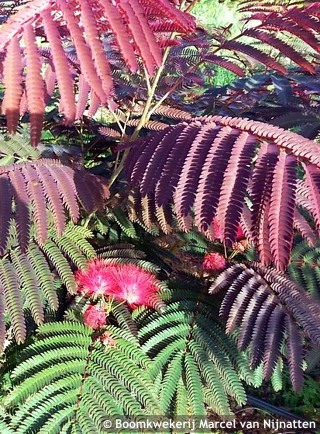
Evi's Pride (also spelled Evey's Pride) is a purple-leaved form of silk tree which boasts with better hardiness and richer flowering as opposed to Summer Chocolate®. Its flowers are rich pink, hairy spheres with nearly white centres, 3-5 cm large and with a sweet fragrance. Fern-like, compound ...
VII - VIII
3 - 5m
3 - 6m
full sun
6   (down to -23°C)
Code of winter protection zone 5+6
for zone 5+6
Code of winter protection zone 7
for zone 7
4359_1.jpeg
TROPICAL DREAM is a silk tree variety from Belgium where it was selected by Johan Possemiers around 1984. It was selected among many seedlings raised from seeds collected around Seoul in South Korea. Though, it took many years to reach the trade as only in 2015 it was first introduced at Plantarium ...
VII - VIII
3 - 5m
3 - 6m
full sun
6   (down to -23°C)
Code of winter protection zone 5+6
for zone 5+6
Code of winter protection zone 7
for zone 7
822_1.jpeg
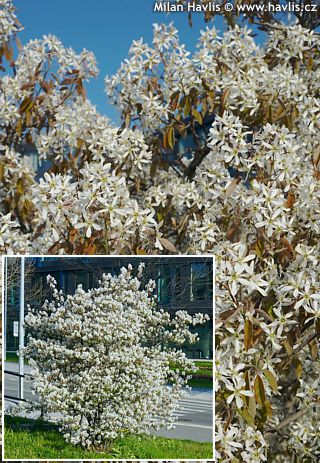
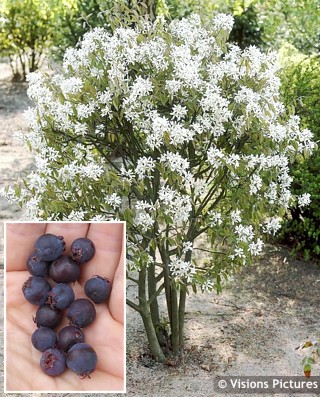
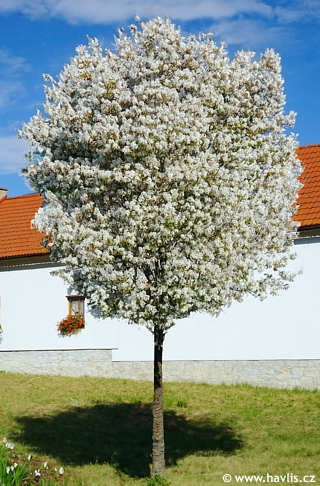
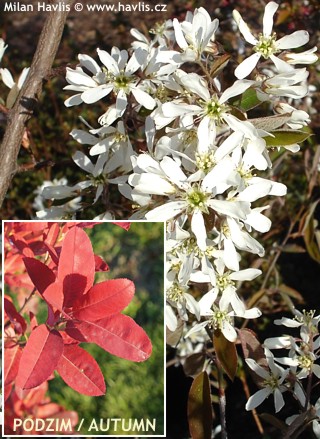
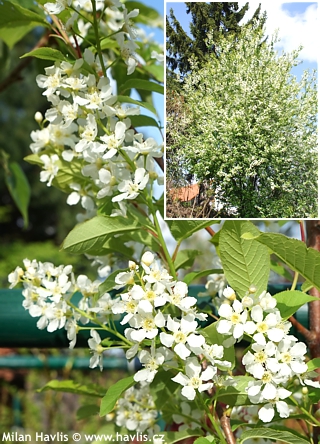
Juneberry is a large shrub cultivated mostly for its delicious and healthy fruit. It is a large deciduous shrub or a small tree. Flowers are star-shaped, white and scented and appear in mid spring. Oval leaves are up to 8 cm long, emerge bronze and mature to green colour, turning scarlet red or dee ...
IV - V
2 - 6m
2 - 5m
full sun
4   (down to -34°C)
Code of winter protection zone 5+6
for zone 5+6
Code of winter protection zone 7
for zone 7
Arbutus unedo
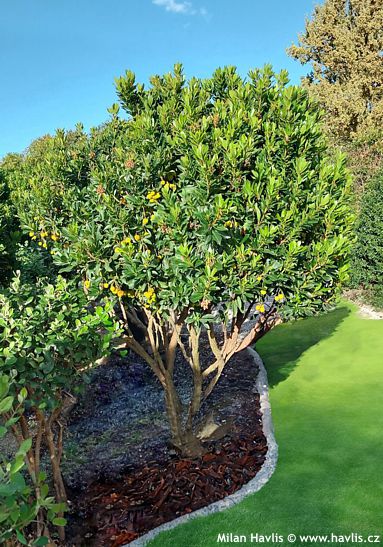
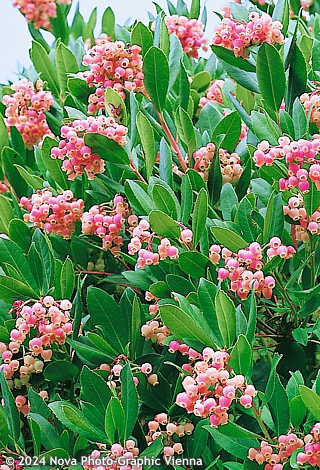
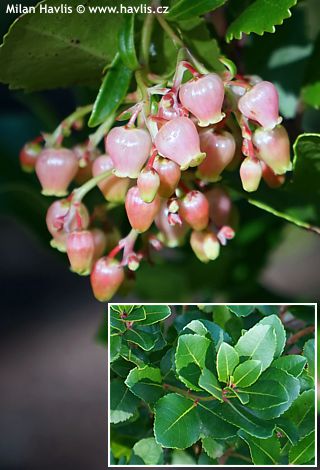
The leaves of the strawberry tree are evergreen, narrowly oval to obovate, 6–10 cm long, leathery, stiff, and with serrated margins that are more pronounced toward the tip. They are bright green and glossy and very handsome. The twigs are slightly orange, reddish when young, and as the bark ages it ...
X - V
2 - 4m
2 - 4m
full to partial sun
6b   (down to -21°C)
Code of winter protection zone 5+6
for zone 5+6
Code of winter protection zone 7
for zone 7
Arbutus unedo 'ATLANTIC'
Atlantic is a French variety of strawberry tree selected and introduced by the Pepinieres Minier in 1993. It boasts a neat and well-behaved, more upright habit, dense branching, and improved hardiness. Its evergreen leaves are narrowly obovate, 5-7 cm long, finely serrated at margins, they emerge br ...
V
2 - 3m
1 - 2m
full sun
6   (down to -23°C)
Code of winter protection zone 5+6
for zone 5+6
Code of winter protection zone 7
for zone 7
4538_1.jpeg
Compacta is a strawberry tree selection found many years ago as a seedling of the species. It boasts a neat and well-behaved habit, dense branching, and improved hardiness. Its evergreen leaves are narrowly obovate, 5-7 cm long, finely serrated at margins, they emerge bronze red and remain soft gree ...
IX - V
1,5 - 3m
1 - 2m
full to partial sun
6   (down to -23°C)
Code of winter protection zone 5+6
for zone 5+6
Code of winter protection zone 7
for zone 7
5713_1.jpeg
Rubra is a common name for all forms of strawberry tree with red flowers. Only those plants which also boast other distinct features were selected and registered as individual varieties. It makes evergreen, narrowly oval to obovate, 6-10 cm long, leathery leaves with serrated margins, more conspicuo ...
X - V
2 - 4m
2 - 4m
full to partial sun
6b   (down to -21°C)
Code of winter protection zone 5+6
for zone 5+6
Code of winter protection zone 7
for zone 7
Arbutus unedo 'QUERCIFOLIA'
Quercifolia is a rare, collector’s selection of strawberry tree that differs from the species in both leaf shape and growth habit. The epithet Quercifolia is common in botanical usage and means “oak‑leaved”; also here it refers to the unusual leaf form, which bears several shallow notches towa ...
XI - XII
1,5 - 4m
1,5 - 4m
full sun
6   (down to -23°C)
Code of winter protection zone 5+6
for zone 5+6
Code of winter protection zone 7
for zone 7
Betula nigra 'SHILOH SPLASH'
Shiloh Splash birch looks like almost anything but a birch. It bears noticeably smaller leaves, richly variegated with creamy white along the margins. It was discovered in 1999 by brothers John and Danny Allen at their Shiloh Nursery in North Carolina, USA, as a spontaneous mutation of the species, ...
3 - 5m
2 - 3m
full sun
3   (down to -40°C)
Code of winter protection zone 5+6
for zone 5+6
Code of winter protection zone 7
for zone 7
26_1.jpeg
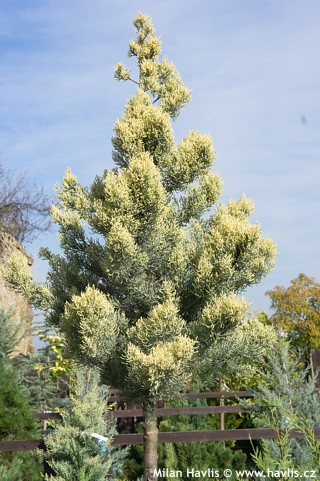
Although this incense cedar is one of the most sought after conifers of the south, it seems to perform much better in Czech climate thanks to cold and wet winters. It needs a lot of sun in summer though to keep its varigated leaves golden. Though, if the sun is not as hot as in the Mediterranean, fo ...
5 - 10m
full to partial sun
5   (down to -29°C)
Code of winter protection zone 5+6
for zone 5+6
Code of winter protection zone 7
for zone 7
3728_1.jpeg
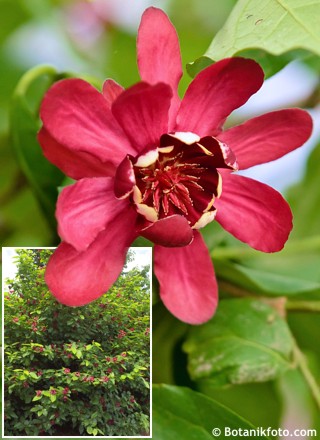
Aphrodite is a beautiful, large-flowered sweetshrub hybrid between c.chinensis and c.occidentalis. The flowers are often compared to magnolias - both in shape and size. They are 7-9 cm across, rich crimson to burgundy red, and appear with the first hot days of May, and continue blooming until late J ...
V - VIII
3 - 4m
2 - 3m
full to partial sun
6   (down to -23°C)
Code of winter protection zone 5+6
for zone 5+6
Code of winter protection zone 7
for zone 7
5160_1.jpeg
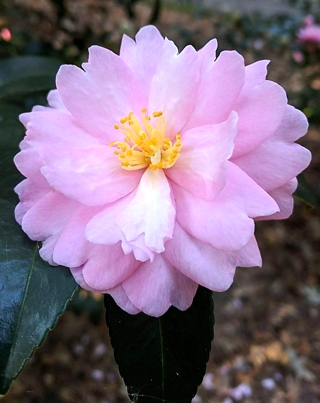
Ashton’s Ballet is an autumn flowering camellia from the Ashton series bred by dr. Ackerman and introduced in 1996. It is a cross between a very hardy species camellia oleifera and Shikishima variety (c. hiemalis). It produces utterly pretty, tutu-like, soft pink, semi-double to fully ...
XI - I
2 - 3m
1 - 2m
semi-shade to shade
6   (down to -23°C)
Code of winter protection zone 5+6
for zone 5+6
Code of winter protection zone 7
for zone 7
3598_1.jpeg
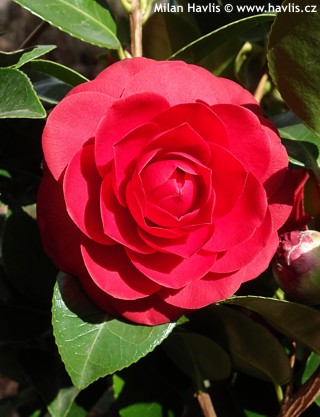
Black Lace is an older and proved variety of hardy camellia, in fact one of the best reds available. Its is a hybrid of c.reticulata and c.williamsii and has so far withstood -20°C. Its fully double, dahlia-like flowers are rich red, and bloom from early April for 6 to 8 weeks if the plant ...
IV - V
1,5 - 3m
1,5 - 2,5m
semi-shade to shade
6   (down to -23°C)
Code of winter protection zone 5+6
for zone 5+6
Code of winter protection zone 7
for zone 7
4056_1.jpeg
Pink Icicle is a showy, large-flowered hybrid camellia bred by dr. Ackermann from the United States National Arboretum. Its semi-double, soft pink flowers are 11 cm across, and open in April for 6-8 weeks. Leaves are evergreen, obovate, gently serrated at margins, deep green, and glossy. It grows fa ...
IV - V
1,8 - 2,5m
1,3 - 1,8m
semi-shade to shade
6b   (down to -21°C)
Code of winter protection zone 5+6
for zone 5+6
Code of winter protection zone 7
for zone 7
4052_1.jpeg
The origin of winter camellia - Camellia hiemalis is unknown, however, rather than a separate species it is believed to be a natural hybrid between spring flowering c.japonica and autumn flowering c.sasanqua. It has been crossed, selected, and propagated for such a long time that ...
XI - V
2 - 3m
1,5 - 2m
semi-shade to shade
6b   (down to -21°C)
Code of winter protection zone 5+6
for zone 5+6
Code of winter protection zone 7
for zone 7
5647_1.jpeg
Alba Simplex is a spring flowering hardy camellia whose origin, despite the availability of multiple historical sources, is rather uncertain. One source claims that it comes from China but does not support it with any further details. Another source says it comes from Germany, registe ...
III - IV
2 - 3m
1,5 - 2m
semi-shade to shade
6   (down to -23°C)
Code of winter protection zone 5+6
for zone 5+6
Code of winter protection zone 7
for zone 7
Camellia japonica 'DR. KING'
Dr. King is a Japanese camellia cultivar, a spring-flowering one, first introduced in 1944 by the Australian nursery Camellia Grove Nursery. It is a large-flowered cultivar with semi-double, highly decorative blooms measuring approximately 8 to 10 cm in diameter. The flowers display a distinctive sh ...
IV - V
2 - 3,5m
2 - 3m
semi-shade to shade
7   (down to -18°C)
Code of winter protection zone 5+6
for zone 5+6
Code of winter protection zone 7
for zone 7
4055_1.jpeg
Kimberley is another old Japanese camellia variety from early 20th century, and awarded AGM by RHS in 1934. It produces beautiful, cup-shaped, rich scarlet red blossoms with a crown of yellow stamens. Flowering begins in April and continues for 6-8 weeks. Leaves are evergreen, narrowl ...
IV - V
2,5 - 3,5m
1,3 - 1,5m
semi-shade to shade
6b   (down to -21°C)
Code of winter protection zone 5+6
for zone 5+6
Code of winter protection zone 7
for zone 7
Camellia japonica 'MATTERHORN'
Matterhorn is a magnificent, large-flowered cultivar of Japanese camellia, a classic spring-flowering variety that in temperate Central European conditions usually blooms from late March into early May. Its flowers are pure white, without any creamy or pink undertones, measuring approximately 8 to 1 ...
IV - V
2 - 3m
2 - 2,5m
semi-shade to shade
7   (down to -18°C)
Code of winter protection zone 5+6
for zone 5+6
Code of winter protection zone 7
for zone 7
1080_1.jpeg
If you like cedars or perhaps if you are a collector or just an enthusiast don’t miss this one. It is a beautiful example of a form that is rarely seen in private gardens or arboretums. Fastigiata is an attractive form of Atlas cedar with strictly narrow, columnar habit. Its evergreen, short need ...
4 - 8m
1 - 2m
full sun
6   (down to -23°C)
Code of winter protection zone 5+6
for zone 5+6
Code of winter protection zone 7
for zone 7
Cedrus atlantica f. FASTIGIATA GLAUCA
Fastigiata Glauca is a blue green or silvery blue version of an attractive form of Atlas cedar Fastigiata with strictly narrow, columnar habit. Its lateral branches are short and densely cover the leader. If a branch goes mad and grows too long in the unwanted direction just clip it, any time of yea ...
4 - 8m
1 - 2m
full sun
6   (down to -23°C)
Code of winter protection zone 5+6
for zone 5+6
Code of winter protection zone 7
for zone 7
1505_1.jpeg
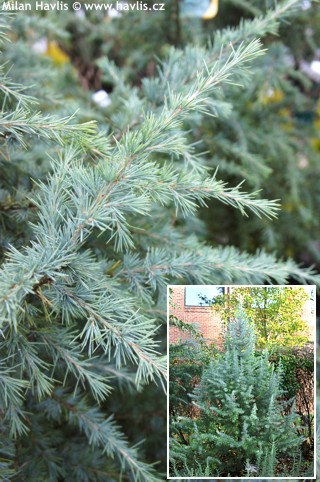
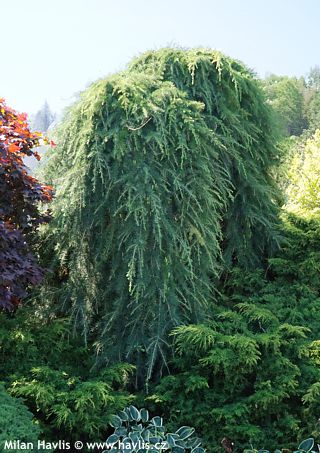
Himalayan cedar is the most graceful of all cedars. Bushes Electra is a slower growing variety bred by Richard Bush in Canby, USA, at the turn of the century. It bears showy, 2-3 cm long, needles of silvery blue colour on insolated parts of the plant, and blue-green color inside the bush. The side b ...
4 - 7m
2 - 3m
full sun
5b   (down to -27°C)
Code of winter protection zone 5+6
for zone 5+6
Code of winter protection zone 7
for zone 7
2207_1.jpeg
Katsura tree is native to China and Japan, and thanks to its versatility it has found many fans among both professionals and general gardening public. It is a large deciduous shrub or very rarely a tree (uneasy to train it into a tree with one central leader). Its leaves emerge pale bronze and quick ...
10 - 15m
3 - 6m
full sun
4   (down to -34°C)
Code of winter protection zone 5+6
for zone 5+6
Code of winter protection zone 7
for zone 7
5067_1.jpeg
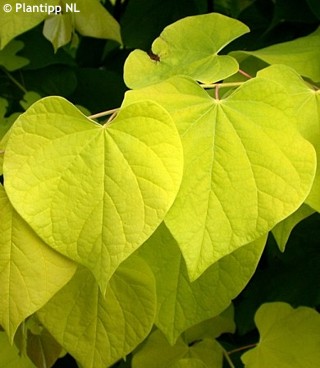
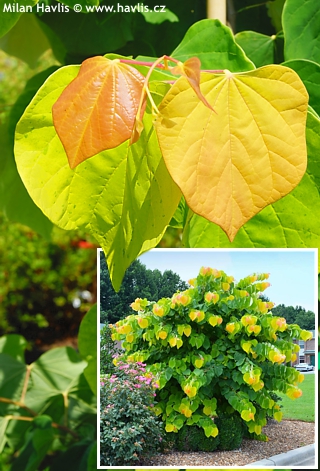
RISING SUN™ is an American variety of Eastern redbud found by Ray and Cindy Jackson for their Jackson Nursery in Belvidere, Tennessee, as a chance seedling. It boasts large, 10-14 cm long and wide, broadly heart-shaped leaves which emerge bright golden or orange while older leaves are bright y ...
IV - V
2 - 4m
2 - 4m
full to partial sun
5   (down to -29°C)
Code of winter protection zone 5+6
for zone 5+6
Code of winter protection zone 7
for zone 7
5618_1.jpeg
Dennis James Werner is a Distinguished Professor of Horticultural Sciences at North Carolina State University in Raleigh, USA, and a breeder who specializes in buddleja, peaches, and redbuds. Regarding the last mentioned he has developed and already patented 8 beautiful varieties, some of which are ...
IV
2 - 4m
2 - 3m
full to partial sun
5   (down to -29°C)
Code of winter protection zone 5+6
for zone 5+6
Code of winter protection zone 7
for zone 7
5597_1.jpeg
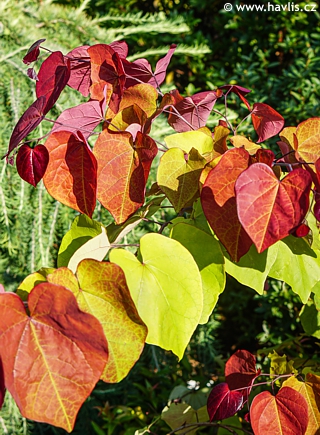
CAROLINA SWEETHEART™ redbud is like fireworks glowing with several colours at once. This darling was developed in cooperation with the Star Roses and Plants Nursery by Thomas G. Ranney from North Carolina State University in the USA, who is also known in our country thanks to his of wonderful ...
IV - V
2 - 4m
2 - 4m
full to partial sun
5   (down to -29°C)
Code of winter protection zone 5+6
for zone 5+6
Code of winter protection zone 7
for zone 7
480_1.jpeg
Venus® is a trade name for this lovely plant. It is truly much nicer than the original variety name “KN30-8”. It is as mathematical as the breeding equation: (cornus kousa „Chinensis“ x cornus nuttalli „Goldspot“ ) x cornus kousa „Rosea“. The res ...
VI - VI
2 - 4m
3 - 5m
full sun
5   (down to -29°C)
Code of winter protection zone 5+6
for zone 5+6
Code of winter protection zone 7
for zone 7
Cornus controversa 'VARIEGATA'
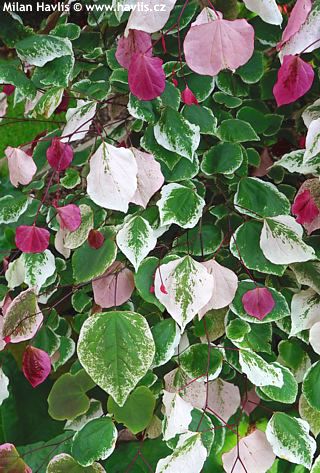
The cultivar Variegata elevates the natural beauty of giant dogwood not by one, but quite possibly by three levels at once. It bears striking green‑and‑white variegated leaves, whose broad creamy margins resemble sugar icing on the tiers of a wedding cake – hence the common name Wedding ...
IV - V
4 - 8m
3 - 6m
full sun
5   (down to -29°C)
Code of winter protection zone 5+6
for zone 5+6
Code of winter protection zone 7
for zone 7
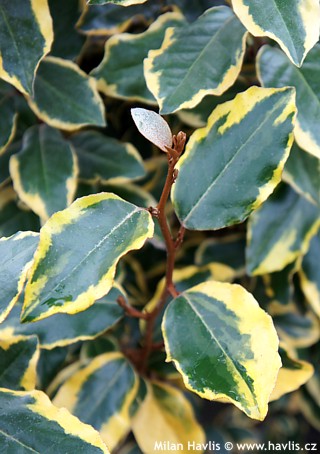
Cornus elliptica (syn. C. angustata) EMPRESS OF CHINA
Empress of China Chinese dogwood stands out above all for its abundant and reliable flowering on a fully leaved, evergreen plant. It produces striking, snow‑white bracts approximately 6–8 cm across, appearing in great numbers and creating an exceptionally clean, almost porcelain‑like eff ...
VI - VII
3 - 5m
3 - 4m
full sun
6b   (down to -21°C)
Code of winter protection zone 5+6
for zone 5+6
Code of winter protection zone 7
for zone 7
5759_1.jpeg
Big Apple is a Japanese dogwood variety from the USA where it was discovered and selected by Polly Hill in the 1960s. The seeds were obtained from M.M. Brubaker of Pennsylvania and as the plants grew she noticed one that was different from the species. She named it Big Apple and while most contempor ...
VI - VII
3 - 5m
2 - 3m
full sun
5   (down to -29°C)
Code of winter protection zone 5+6
for zone 5+6
Code of winter protection zone 7
for zone 7
Cornus kousa (var. chinensis)
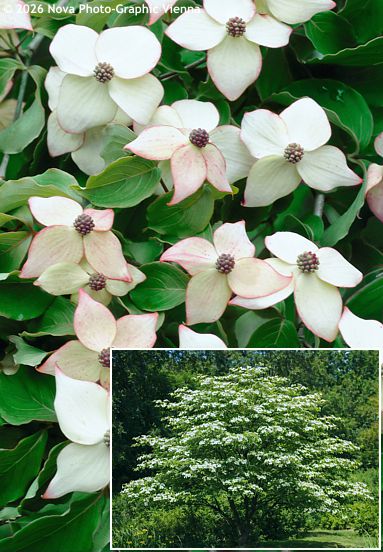
Japanese dogwood is a showy, beautifully structured deciduous shrub native to Asia. It most often flowers in June and, like many plant species, it is something of a trickster, because the attractive parts visible at first glance are not the true flowers themselves but the coloured bracts surrounding ...
V - VI
3 - 9m
3 - 9m
full to partial sun
5   (down to -29°C)
Code of winter protection zone 5+6
for zone 5+6
Code of winter protection zone 7
for zone 7
3649_1.jpeg
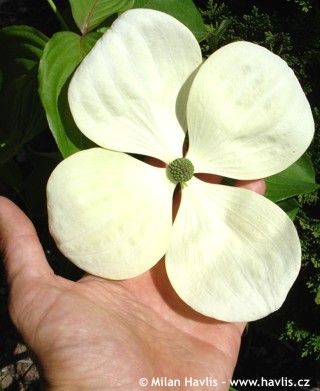
SCARLET FIRE® is a proper Japanese dogwood, not a hybrid, so a plant which flowers later than American dogwoods, on already leafed-out trees (shrubs). The flowers are in fact bracts. There are 4, rich magenta pink, oval, sharply pointed bracts, composed around a small flower head, about 13 cm across ...
V - VI
3 - 4m
2 - 3m
full sun
5   (down to -29°C)
Code of winter protection zone 5+6
for zone 5+6
Code of winter protection zone 7
for zone 7
547_1.jpeg
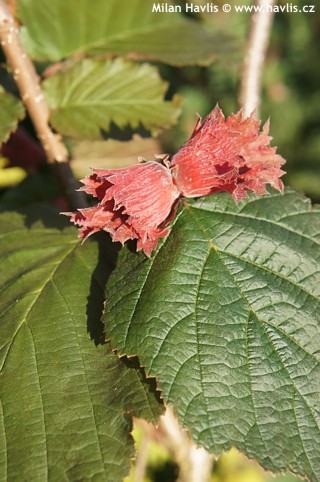
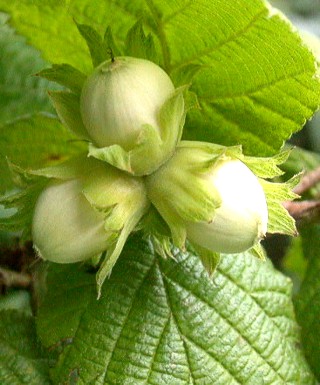
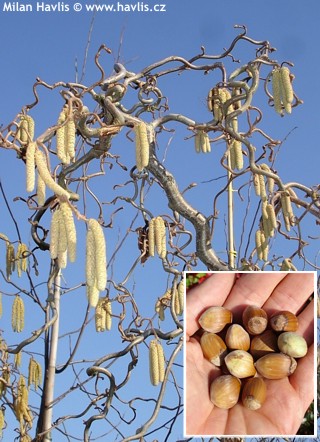
Hazel is a well-known shrub of European woodlands which is popular mainly for its nuts. It is a suckering, thicket-forming shrub with numerous upright stems. As it is a dense and large shrub it is used as a screening plant. It will also make a wild hedge which should be controlled if required compa ...
II - III
2 - 4m
full to partial sun
4   (down to -34°C)
Code of winter protection zone 5+6
for zone 5+6
Code of winter protection zone 7
for zone 7
5405_1.jpeg
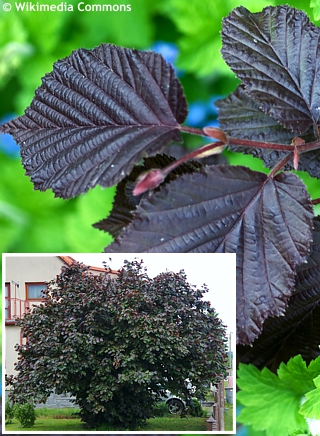
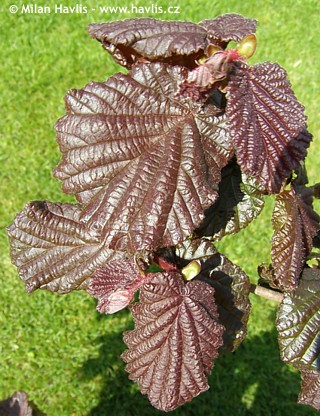
Filbert is a hazelnut species from S.E. Europe and S.W. Asia and exhibits a vigorously growing many-stemmed shrub with deciduous leaves. Purpurea is an old variety with deep maroon to near black leaves. They are 5-12 cm long, 4-10 cm wide, and during summer the colour of maturing leaves changes to d ...
II - III
3 - 6m
3 - 6m
full sun
4   (down to -34°C)
Code of winter protection zone 5+6
for zone 5+6
Code of winter protection zone 7
for zone 7
105_1.jpeg
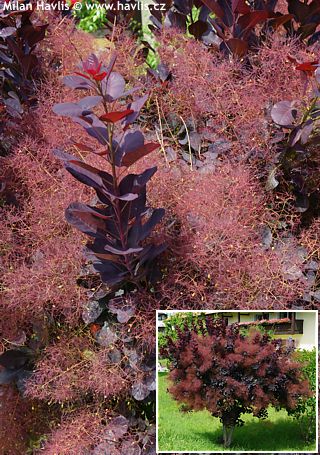
Smoke tree might have a slight problem these days when smoking outside becomes prohibited ... just joking, the alleged smoke is what flowering of this shrub looks like. It blooms from June to July and from a distance the clusters do look like purple smoke. The leaves of Royal Purple are deep burgund ...
VI - VII
2 - 5m
full to partial sun
5   (down to -29°C)
Code of winter protection zone 5+6
for zone 5+6
Code of winter protection zone 7
for zone 7
Crataegosorbus 'GRANATNAJA'
Granatnaja is a Russian cultivar of crataegosorbus - a medium-sized tree with edible fruit. Its leaves are odd-pinnate, with lanceolate to elliptical, finely serrated leaflets that resemble hawthorn more than rowan, reflecting its hybrid origin. In autumn, the foliage turns vibrant shades of red-ora ...
IV - V
3 - 6m
3 - 4m
full to partial sun
4   (down to -34°C)
Code of winter protection zone 5+6
for zone 5+6
Code of winter protection zone 7
for zone 7
5057_1.jpeg
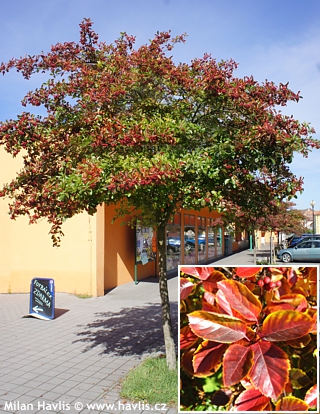
Splendens hawthorn is undoubtedly one of the most beautiful trees of northern hemisphere not only among hawthorns. It is valued for its lush, glossy foliage and a profusion of red berries. Leaves are deciduous, broadly elliptic, serrated at margins, dark green in spring and summer, and take on vibra ...
V - VI
4 - 7m
3 - 4m
full to partial sun
4   (down to -34°C)
Code of winter protection zone 5+6
for zone 5+6
Code of winter protection zone 7
for zone 7
1057_1.jpeg
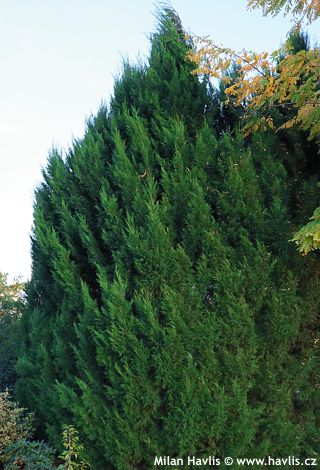
Elegans Viridis is one of those Japanese cedar cultivars that one remembers at first sight. Even as a young plant it looks as if it were wrapped in soft, delicate feathers that ripple lightly with every breath of wind. The needles are soft and threadlike yet structured, held on the branches in dense ...
2 - 6m
2 - 3m
full to partial sun
5b   (down to -27°C)
Code of winter protection zone 5+6
for zone 5+6
Code of winter protection zone 7
for zone 7
1307_1.jpeg
Sekkan Sugi is a gorgeous evergreen conifer not only for Japanese gardens. It forms a fat, cone-shaped shrub or small tree with bright, sulphur-yellow or creamy-yellow new growths. They remain yellow throughout the year until next spring when they turn deep green and are replaced by new foliage that ...
3 - 8m
2 - 3m
full to partial sun
5b   (down to -27°C)
Code of winter protection zone 5+6
for zone 5+6
Code of winter protection zone 7
for zone 7
219_1.jpeg
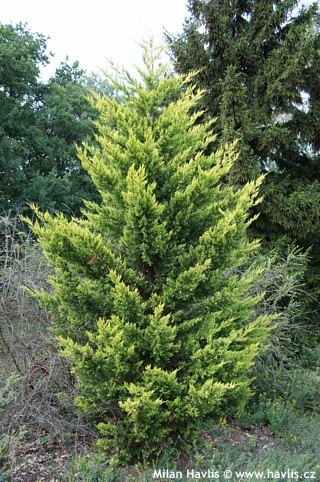
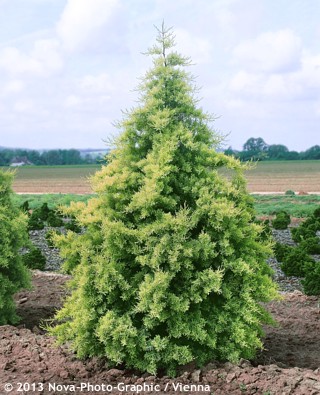
Gold Rider is still quite new in the Leyland cypress family. It produces flattened sprays of bright yellow-green, scale-like leaves. The branches are not pendent, not erect. Something in between and that makes it stand apart from chamaecyparis. The big advantage of Leyland cypress is the fact that i ...
2 - 10m
2 - 4m
full to partial sun
5b   (down to -27°C)
Code of winter protection zone 5+6
for zone 5+6
Code of winter protection zone 7
for zone 7
1020_1.jpeg
Fastigiata Arizona cypress is a favourite even in gardens where conifers aren’t typically welcome, thanks to its distinctive character, texture, and color. It grows upright and compact, with branches forming a sharper angle with the trunk, emphasizing its columnar habit. The foliage is soft to the t ...
5 - 10m
2 - 5m
full sun
5   (down to -29°C)
Code of winter protection zone 5+6
for zone 5+6
Code of winter protection zone 7
for zone 7
1083_1.jpeg
The cultivar Fastigiata Aurea of the Arizona cypress is a true delicacy among conifers. It likely originated as a horticultural selection in France during the second half of the 20th century, although precise details about its development are not documented in the literature. Unlike ‘Fastigiata’, it ...
3 - 6m
1 - 2m
full sun
6   (down to -23°C)
Code of winter protection zone 5+6
for zone 5+6
Code of winter protection zone 7
for zone 7
1782_1.jpeg
The cultivar Sulphurea of the Arizona cypress was bred in France in 1963 and stands out like a sunbeam among conifers – its young shoots shine with a bright yellow hue that gradually matures into a warm chartreuse tone but never fades completely. It grows upright, with looser branching than ‘Fastigi ...
3 - 6m
2 - 3m
full sun
5   (down to -29°C)
Code of winter protection zone 5+6
for zone 5+6
Code of winter protection zone 7
for zone 7
Cupressus sempervirens 'TOTEM'
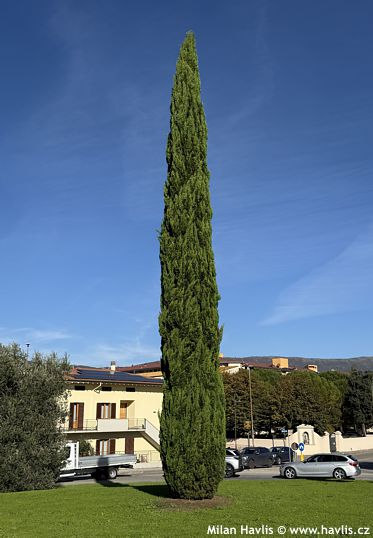
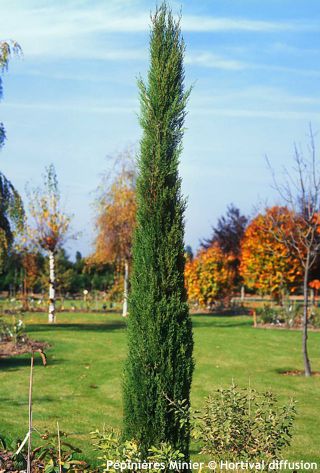
Now for the cultivar Totem. The name itself suggests a plant with the character of a sculpture – and that is exactly what it is. Totem is an extremely narrow, columnar cultivar of Tuscan cypress, like a green sword thrust into the ground. It grows slowly yet steadily, holding its shape like a soldie ...
4 - 8m
0,5 - 1m
full sun
7   (down to -18°C)
Code of winter protection zone 5+6
for zone 5+6
Code of winter protection zone 7
for zone 7
Davidia involucrata (S.H.N.) 'SONOMA'
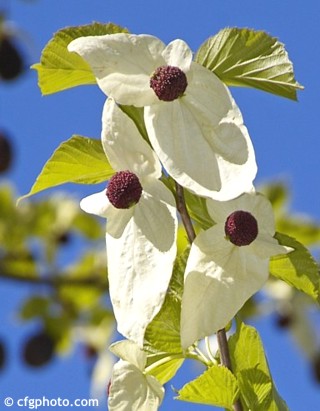
Sonoma is a smaller, garden‑friendly form of Davidia that will not overwhelm a garden with its size yet offers flowers much earlier and often in greater abundance. The true flowers are arranged in a small, rounded inflorescence of inconspicuous green florets with wine‑red stamens, surrou ...
V - VI
4 - 6m
2 - 4m
full to partial sun
5b   (down to -27°C)
Code of winter protection zone 5+6
for zone 5+6
Code of winter protection zone 7
for zone 7
18_1.jpeg
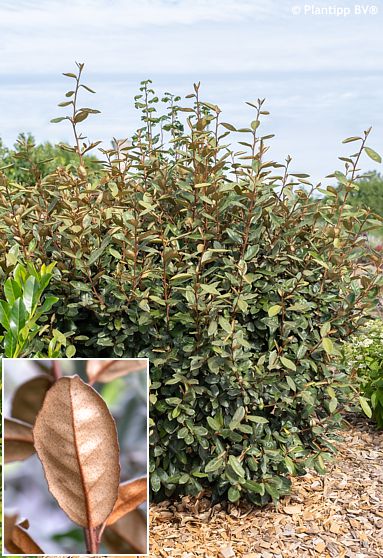
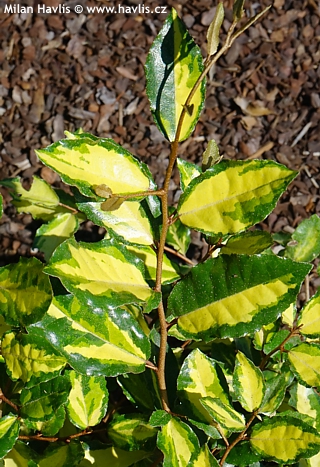
Limelight is my personal favourite among evergreen silverthorns. It has ovate, up to 10 cm long, leathery but thin leaves that are bright yellow in the middle and deep green at margins. The area between the centres and margins is light, soft green so the overall effect is 3-coloured. Newly emerging ...
2 - 3m
1 - 2m
full to partial sun
6   (down to -23°C)
Code of winter protection zone 5+6
for zone 5+6
Code of winter protection zone 7
for zone 7
2215_1.jpeg
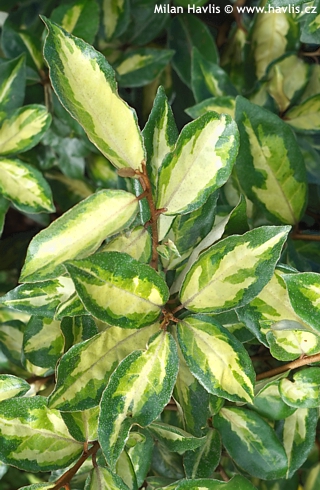
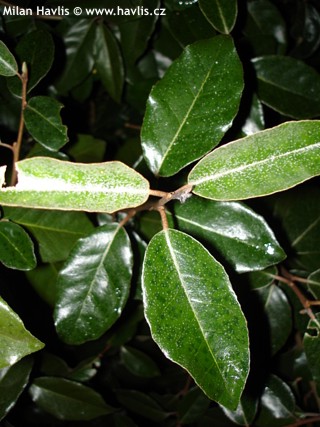
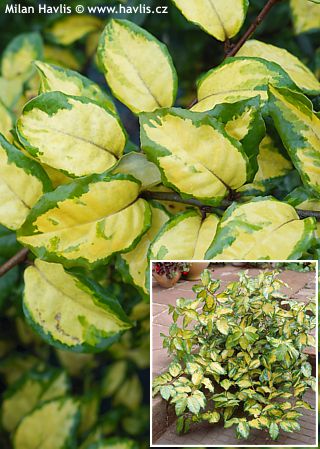
Viveleg silverthorn is a bushy, upright growing, evergreen shrub with irregularly variegated leaves. They are leathery, oval to ovate, partially undulated, and glossy. The centres are dark green, the margins are rich yellow, and the borderline between these two colours is light green but is not pres ...
IX - X
2 - 3m
1 - 2m
full to partial sun
6   (down to -23°C)
Code of winter protection zone 5+6
for zone 5+6
Code of winter protection zone 7
for zone 7
4209_1.jpeg
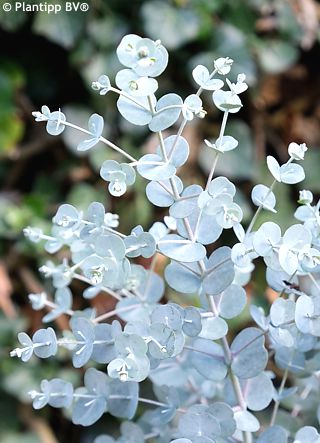
In 2006, a miracle occurred that at first looked rather ominous – in a French nursery, all seedlings of this botanical species froze except for a single plant, even though everyone was convinced of its suitability for the French climate. One eucalyptus, one pot, survived an unusually severe winter t ...
5 - 10m
2 - 4m
full to partial sun
6   (down to -23°C)
Code of winter protection zone 5+6
for zone 5+6
Code of winter protection zone 7
for zone 7
4646_1.jpeg
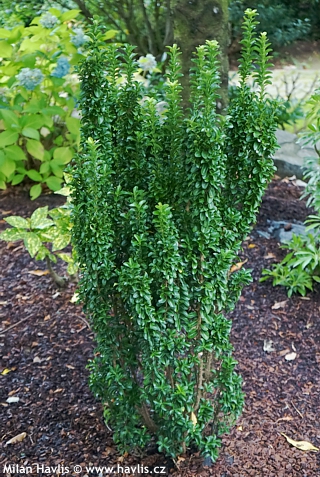
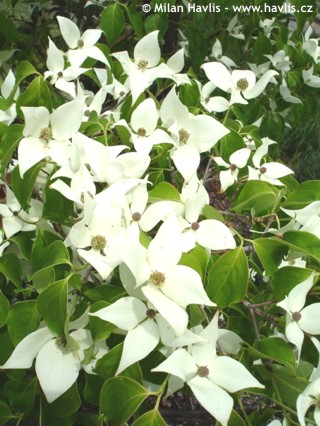
GREEN SPIRE is a Japanese spindle selection introduced to market around 2000. It exhibits a strictly upright habit with neatly erect branches, densely covered with 3 cm long, oval, deep green, highly glossy, evergreen leaves with gently serrated margins. One would even say that one of its parents mu ...
1 - 2m
0,5 - 0,8m
full sun to shade
6   (down to -23°C)
Code of winter protection zone 5+6
for zone 5+6
Code of winter protection zone 7
for zone 7
1732_1.jpeg
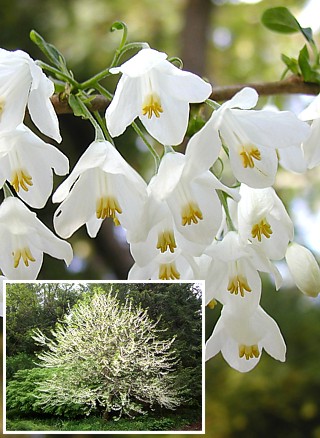
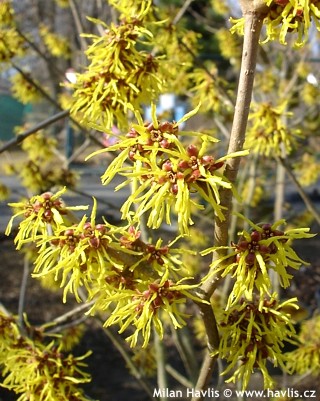
Silver bell is a gorgeous shrub whose other name is probably even more accurate: snowdrop tree. Its origin is SE USA and it is still quite rare in Europe although it is easy to grow and hardy. Silver bell is cultivated mostly for its snow-white bell-shaped flowers produced in masses in late April a ...
IV - V
4 - 7m
3 - 4m
full sun
5   (down to -29°C)
Code of winter protection zone 5+6
for zone 5+6
Code of winter protection zone 7
for zone 7
3129_1.jpeg
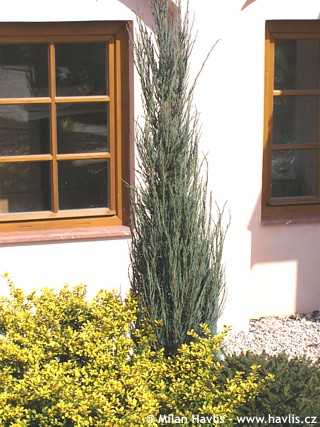
Barmstedt Gold Vilín is unique in its flower colour. It is not sulphur yellow like many other yellow flowering varieties. This one is truly golden yellow with a hint of light orange. The flowers are fringe-like and very fragrant, their perfume is strongly fruity with a little bit of spice. They come ...
I - III
2 - 3m
2 - 3m
full sun
5   (down to -29°C)
Code of winter protection zone 5+6
for zone 5+6
Code of winter protection zone 7
for zone 7
464_1.jpeg
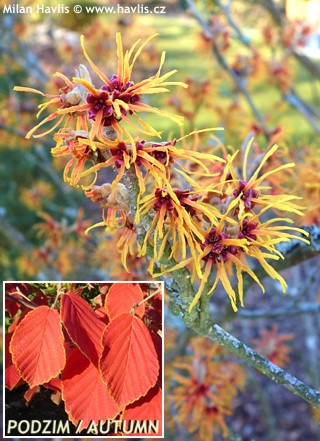
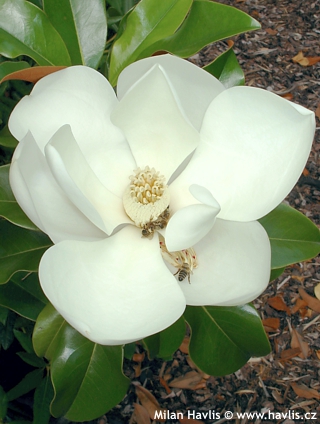
Jelena is my top favourite witch hazel, and historically the very first orange flowering variety in the world. It produces masses of fiery orange, fringe-like, beautifully scented flowers early in the season. If the weather is sunny and warm it may produce its first flowers from January and continue ...
I - III
2 - 3,5m
2 - 3,5m
full to partial sun
5   (down to -29°C)
Code of winter protection zone 5+6
for zone 5+6
Code of winter protection zone 7
for zone 7
1593_1.jpeg
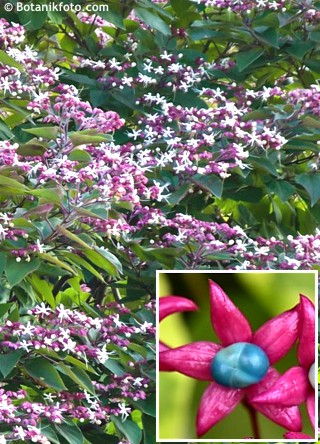
Seven son flower is a fascinating shrub that was first found in China by Ernest H.Wilson more than a hundred years ago, in 1907. Still, it took almost 80 years before this plant was cultivated commercially. Seven son flower is a large shrub or a small tree with 3 predominant features. Leaves, inflo ...
VIII - X
3 - 5m
2 - 3m
full to partial sun
5b   (down to -27°C)
Code of winter protection zone 5+6
for zone 5+6
Code of winter protection zone 7
for zone 7
Hibiscus ‚Walhiecli‘ WALBETRON’S® LUNAR® ECLIPSE
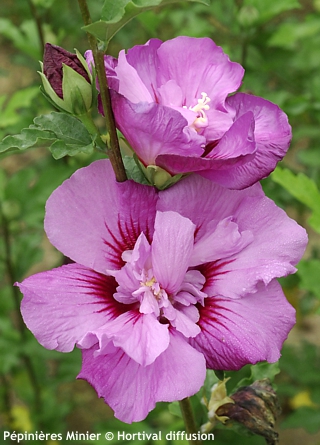
If you have known Rose-of-Sharon for many years and think nothing could surprise you, lo and behold — before you stands this beauty. The special Walberton’s® Lunar® series looks as if it had slipped out of a tropical glasshouse into an ordinary European garden — and yet, for all its exotic air, it i ...
VII - IX
2 - 3m
1 - 1,8m
full sun
6   (down to -23°C)
Code of winter protection zone 5+6
for zone 5+6
Code of winter protection zone 7
for zone 7
5693_1.jpeg
Resi is a Dutch variety of hybrid hibiscus (h. syriacus x h. paramutabilis) bred by Piere Theunissen and introduced by the nursery Piet Vergeldt Boomkwekerijen in 2008. In the US it is sold under the brand name FULL BLAST™. European Patent No. 33825 was granted in 2013 (expired in 2021). It be ...
VII - IX
3 - 5m
2 - 3m
full sun
5   (down to -29°C)
Code of winter protection zone 5+6
for zone 5+6
Code of winter protection zone 7
for zone 7
5514_1.jpeg
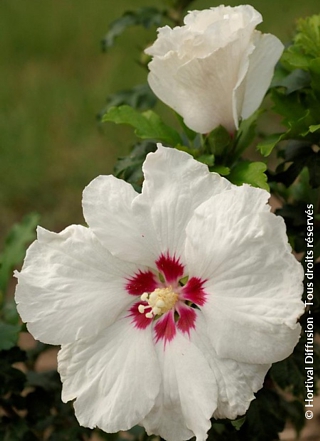
FLOWER TOWER WHITE is an upright and slender growing variety of rose-of-Sharon with large, single flowers with a few toussled sepals in the centre which lacks maroon eye so the flowera are overall clean and snow-white. Their diameter is 8-10 cm and they come out from mid-July until September if the ...
VII - IX
2 - 3m
0,5 - 1m
full sun
5   (down to -29°C)
Code of winter protection zone 5+6
for zone 5+6
Code of winter protection zone 7
for zone 7
5006_1.jpeg
ERUPTION® is a Rose-of-Sharon variety with large, up to 10 cm wide flowers. They are semi-double i.e. producing 5 large petals and several dwarf sepals in the centre whose size and quantity increases with age. They are glowing purple pink in colour and decorated with a conspicuous maroon eye an ...
VII - IX
1,5 - 3m
1 - 1,3m
full sun
5   (down to -29°C)
Code of winter protection zone 5+6
for zone 5+6
Code of winter protection zone 7
for zone 7
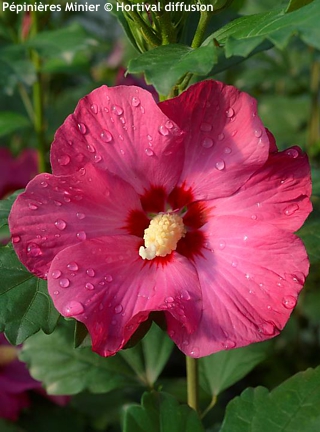
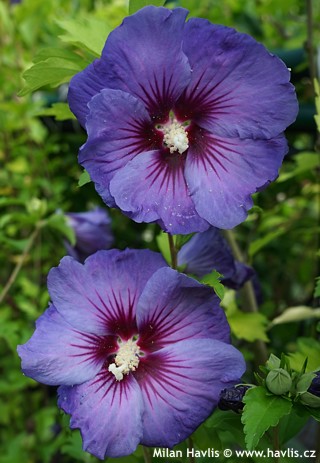
Hibiscus syriacus 'Minsybfcble17' BEAUTIFULL® COBALT
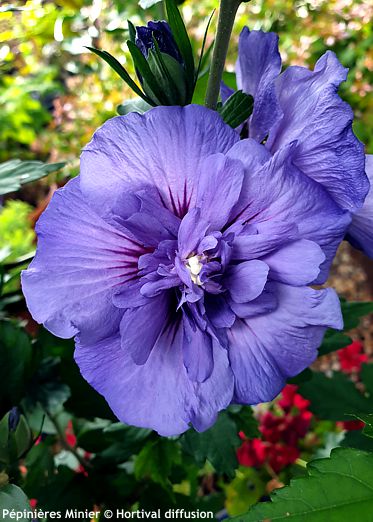
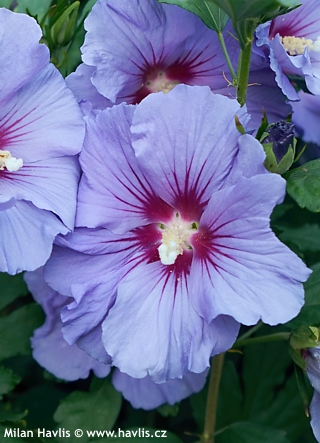
Not many growers specialize in breeding Rose-of-Sharon, so when someone devotes themselves to it purposefully and over the long term, they soon become recognized in their field. One such prominent research station is Hortival Diffusion in France — the new name for the Minier nursery, founded al ...
VII - IX
2 - 3m
1 - 1,5m
full sun
5   (down to -29°C)
Code of winter protection zone 5+6
for zone 5+6
Code of winter protection zone 7
for zone 7
Hibiscus 'Walhirhap' WALBERTON'S LUNAR RHAPSODY
If you have known hardy hibiscus for many years and think nothing could surprise you, lo and behold — before you stands this beauty. The special Walberton’s® Lunar® series looks as if it had slipped out of a tropical glasshouse into an ordinary European garden — and yet, for all its exotic air, it i ...
VII - IX
2 - 3m
1 - 1,8m
full sun
6   (down to -23°C)
Code of winter protection zone 5+6
for zone 5+6
Code of winter protection zone 7
for zone 7
Hydrangea paniculata 'KYUSHU'
Kyushu is a time‑tested cultivar of panicle hydrangea, rightly regarded today as a classic. It is an upright, medium‑ to strongly‑growing shrub with a naturally open habit; in maturity it commonly reaches 1.5–2.5 m in height and about 1–1.5 m in width. It produces tall, conical inf ...
VII - IX
1,5 - 2,5m
1,5 - 2,5m
full to partial sun
4   (down to -34°C)
Code of winter protection zone 5+6
for zone 5+6
Code of winter protection zone 7
for zone 7
Hydrangea paniculata 'SMNHPM' QUICK FIRE FAB
The Quick Fire® series of panicle hydrangeas was launched in 2005 with the goal of extending the flowering season and offering cultivars with exceptionally early blooms. Developed by American breeder Tim Wood of Spring Meadow Nursery, the series aimed to combine sturdy stems, changing flower coloura ...
VI - IX
1,5 - 1,8m
1 - 1,3m
full to partial sun
4   (down to -34°C)
Code of winter protection zone 5+6
for zone 5+6
Code of winter protection zone 7
for zone 7
5645_1.jpeg
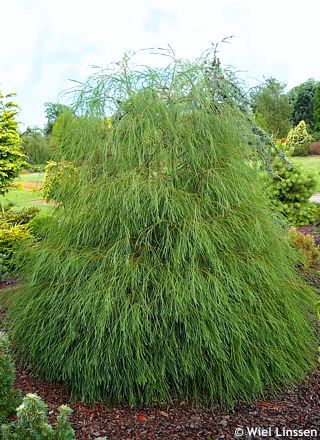
Drooping Solo is a Lawson cypress variety discovered by a Dutch conifer lover and horticulturist Wiel Linssen from Baexem. It was a seedling mutation of Imbricata Pendula, a similar variety of much taller but narrower habit. Drooping Solo forms dense shrubs of a broadly pyramidal shape with drooping ...
2 - 3m
1,5 - 2m
full to partial sun
5   (down to -29°C)
Code of winter protection zone 5+6
for zone 5+6
Code of winter protection zone 7
for zone 7
4045_1.jpeg
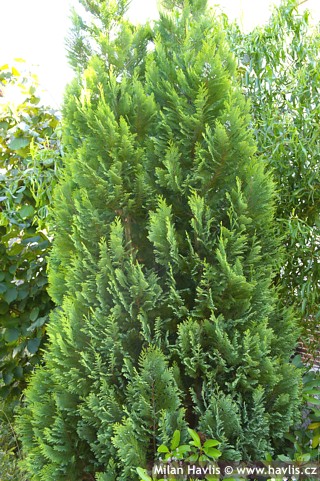
Ellwood's Empire is a natural mutation of an old and proved Ellwoodii Lawson cypress. Its scale-like needles are medium green with blue-green hues, and in spring its tips emerge bright lime-green or almost yellow-green which makes the whole shrub look very fresh and bright. It grows rather slowly in ...
1,5 - 2,5m
0,5 - 1m
full to partial sun
5   (down to -29°C)
Code of winter protection zone 5+6
for zone 5+6
Code of winter protection zone 7
for zone 7
515_1.jpeg
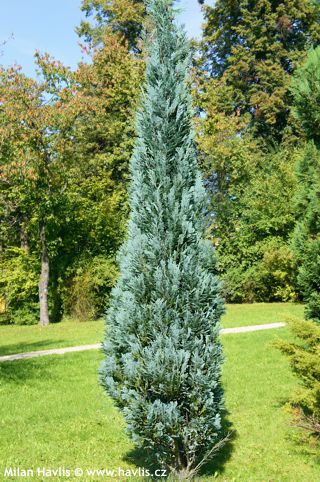
Cypress trees and shrubs are very popular for their variable shapes, leaf types and colours. Variety Columnaris has blue needles and compact shape. It does not grow wider than 1m which makes it ideal for hedges that are only trimmed at the top. Mature plants can reach 6-8m in many decades, they are ...
3 - 6m
1 - 1m
full to partial sun
5   (down to -29°C)
Code of winter protection zone 5+6
for zone 5+6
Code of winter protection zone 7
for zone 7
5039_1.jpeg
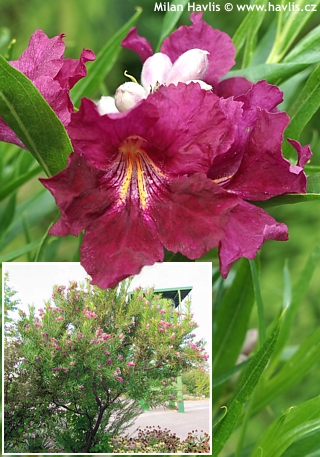
Burgundy is a beautiful variety of desert willow of untraceable origin, possibly a selection of Rio Salado with slightly paler flowers. Burgundy desert willow makes deep maroon, velvety flowers with white and yellow stripes in the throat. They are slightly fragrant and formed in narrow, terminal, up ...
VI - IX
2 - 5m
2 - 4m
full sun
6   (down to -23°C)
Code of winter protection zone 5+6
for zone 5+6
Code of winter protection zone 7
for zone 7
23_1.jpeg
The cultivar Pink Dawn is the principal selection of ×Chitalpa tashkentensis, chosen from the original lines bred by N. F. Rusanov in Tashkent. It was introduced to the United States in 1977 and quickly became the most widespread form thanks to its reliability and long flowering season. Its blossoms ...
VI - VIII
4 - 6m
3 - 4m
full sun
5   (down to -29°C)
Code of winter protection zone 5+6
for zone 5+6
Code of winter protection zone 7
for zone 7
24_1.jpeg
The cultivar SUMMER BELLS of chitalpa boasts abundant and prolonged flowering throughout summer, from June to August. The inflorescences are upright clusters shaped like slender pyramids, reaching 10 to 20 cm in height, composed of exquisite orchid‑like blossoms that combine light pink to lila ...
VI - VIII
4 - 6m
3 - 4m
full sun
5   (down to -29°C)
Code of winter protection zone 5+6
for zone 5+6
Code of winter protection zone 7
for zone 7
4588_1.jpeg
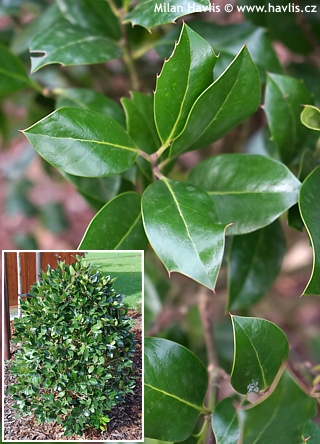
Mary Nell is a hybrid holly from the USA, bred by Joe McDaniels in Tom Dodd Nursery in Alabama in 1962. It is a cross between large-leaved holly ilex latifolia and hybrid holly Red Delight which is a cross between ilex cornuta and ilex pernyi. Joseph C. McDaniels (1912-1982) was a renowned horticult ...
3 - 4m
1,5 - 2m
full to partial sun
6   (down to -23°C)
Code of winter protection zone 5+6
for zone 5+6
Code of winter protection zone 7
for zone 7
128_1.jpeg
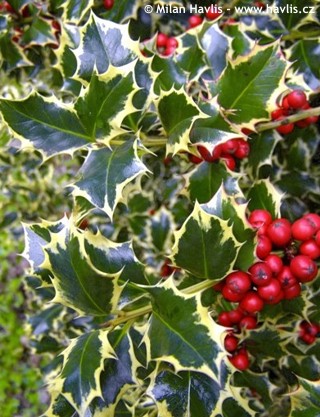
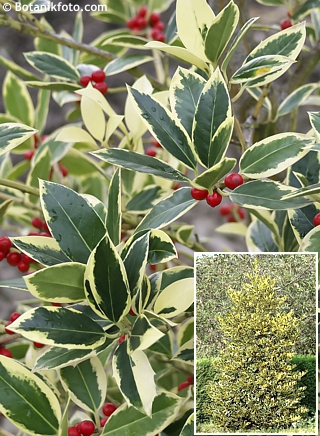
Argentea Marginata is an eye-catching cultivar of variegated English holly. Its sharply serrated, evergreen leaves are almost identical to those of the species but moreover are decorated with a wide brim of creamy white colour at margins. Young leaves show prominent purple red to dark pink hues as t ...
2 - 6m
2 - 4m
full to partial sun
5b   (down to -27°C)
Code of winter protection zone 5+6
for zone 5+6
Code of winter protection zone 7
for zone 7
4341_1.jpeg
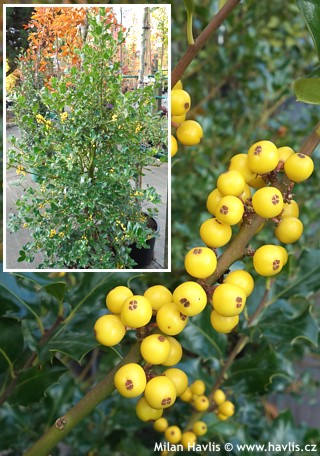
Ingramii is a male English holly variety whose origin I did not manage to find. There are notes about its existence yet before 2000 but it appears to be commercially attractive only from about 2015 or so. It makes heavily toothed, mid-sized leaves or deep green colour with rich silver-white marblin ...
1 - 1,8m
1 - 1,8m
full to partial sun
5b   (down to -27°C)
Code of winter protection zone 5+6
for zone 5+6
Code of winter protection zone 7
for zone 7
Ilex aquifolium 'LICHTENTHALII'
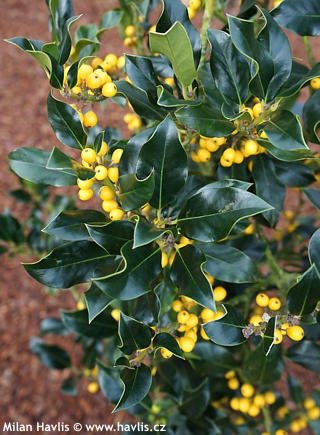
Lichtenthalii is a cultivar of European holly whose origins remain shrouded in mystery. You may come across it here and there in collectors’ gardens, occasionally in arboreta devoted to evergreen trees, but no one can tell you where it truly came from. Its name points to Lichtenthal near Baden‑ ...
1,5 - 2,5m
1,5 - 2,5m
full to partial sun
6   (down to -23°C)
Code of winter protection zone 5+6
for zone 5+6
Code of winter protection zone 7
for zone 7
340_1.jpeg
Lawsoniana is my favourite. It is a female, variegated version of male plant Hendersonii which is just green. The leaves of Lawsoniana are deep green at the margins, grading through light green towards bright yellow centres. They are curled which gives the plant an extraordinary appearance. Being a ...
1,5 - 4m
1 - 2,5m
full to partial sun
6   (down to -23°C)
Code of winter protection zone 5+6
for zone 5+6
Code of winter protection zone 7
for zone 7
Ilex x altaclerensis 'RIPLEY GOLD'
Ripley Gold is a beautiful, variegated cultivar of Highclere holly from the second half of the 20th century (unfortunately, more precise details of its origin have not been preserved). Its evergreen leaves are broadly oval, usually smooth and spineless (entire-margined), slightly undulated, dark gre ...
3 - 5m
2 - 3m
full to partial sun
6   (down to -23°C)
Code of winter protection zone 5+6
for zone 5+6
Code of winter protection zone 7
for zone 7
4810_1.jpeg
Little Stranger is a rare, compact growing blue holly variety from Germany. It is an upright, slow growing shrub with evergreen foliage. Leaves are very dark green, narrowly lance-shaped, almost spineless or just gently serrated at margins, and very glossy. As a male variety it has no fruit but is a ...
2 - 3m
1 - 1,5m
full to partial sun
5   (down to -29°C)
Code of winter protection zone 5+6
for zone 5+6
Code of winter protection zone 7
for zone 7
522_1.jpeg
Heckenfee® is a new variety of blue holly from Germany, bred by Hans Hachmann and patented only in 2000. It is a female variety of its male form Heckenstar. This means that this cross produces berries. Outside Europe it is distributed under trade name Castle Spire™. Heckenfee® is a ...
2 - 3m
1 - 1,5m
full sun to shade
5   (down to -29°C)
Code of winter protection zone 5+6
for zone 5+6
Code of winter protection zone 7
for zone 7
4797_1.jpeg
HECKENBLAU® ('Hedge Blue') is another Hecken- variety of so-called blue holly, again from Germany. It is an upright, moderately growing shrub with evergreen foliage. Leaves are dark green, broadly elliptic to almost rounded, gently serrated at margins but not prickly, and very glossy. Young lea ...
2 - 3,5m
1 - 1,5m
full to partial sun
5   (down to -29°C)
Code of winter protection zone 5+6
for zone 5+6
Code of winter protection zone 7
for zone 7
1866_1.jpeg
Hibernica juniper belongs among the oldest cultivated columnar forms of common juniper, and its origin is traditionally associated with Ireland (Hibernia), from which its name is derived. It is not the result of deliberate breeding, but rather a selection of a naturally upright form from the wild, i ...
3 - 5m
1 - 2m
full sun
3   (down to -40°C)
Code of winter protection zone 5+6
for zone 5+6
Code of winter protection zone 7
for zone 7
1053_1.jpeg
Coral Sun® is a fascinating new variety of golden-rain tree. It was found by Henny Kolster as a natural mutation among many seedlings in his Dutch nursery in Boskoop in 1993. For three years he had been grafting it onto the koelreuteria paniculata species rootstock and all new plants proved to ...
3 - 7m
2 - 5m
full sun
5   (down to -29°C)
Code of winter protection zone 5+6
for zone 5+6
Code of winter protection zone 7
for zone 7
Laburnocytisus adamii
At first glance, Adam's laburnum looks like an ordinary laburnum – an upright shrub or small tree with an open crown and smooth grey-green bark. But a closer look at the branches reveals that something is amiss. Some shoots bear the typical trifoliate leaves of laburnum, others have the smaller, ov ...
V - VI
3 - 5m
2 - 3m
full sun
5   (down to -29°C)
Code of winter protection zone 5+6
for zone 5+6
Code of winter protection zone 7
for zone 7
5579_1.jpeg
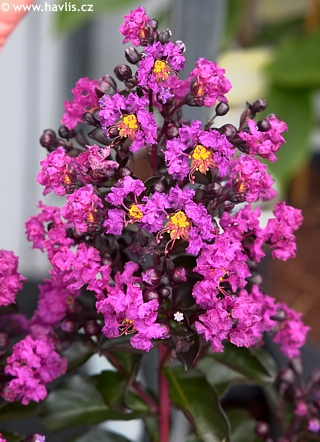
Sioux is another successful cold-hardy crape myrtle hybrid variety from the US National Arboretum. It forms compact, fast and upright growing shrubs or small trees of a narrow habit. The flowers are medium pink and glow like neon. They are arranged in upright panicles and appear, according to the qu ...
VIII - X
2 - 5m
2 - 4m
full sun
6   (down to -23°C)
Code of winter protection zone 5+6
for zone 5+6
Code of winter protection zone 7
for zone 7
3990_1.jpeg
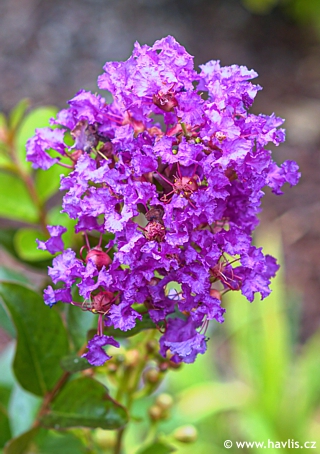
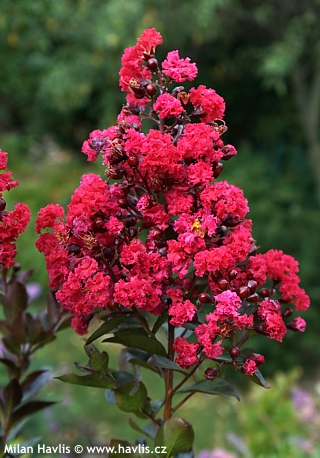
Tuskegee is among the first crepe myrtle hybrids ever crossed in the effort to gain a hardier variety. It makes large panicles 15-20 cm long of rich pin-red, crepe flowers with yellow anthers from August until September. Deciduous leaves are elliptic to obovate, very glossy, they emerge with burgun ...
VIII - IX
2 - 3,5m
2 - 3m
full sun
6   (down to -23°C)
Code of winter protection zone 5+6
for zone 5+6
Code of winter protection zone 7
for zone 7
5458_1.jpeg
Excelsum Superbum is a highly attractive, variegated form of glossy privet. It makes large, up to 15 cm long and 6 cm wide, ovate to oval, pale dark green leaves abundantly variegated butter yellow, often extended to the midribs. Directly contradicting its botanical name they are NOT glossy, they ar ...
IX - X
2 - 5m
1 - 2m
full sun
7   (down to -18°C)
Code of winter protection zone 5+6
for zone 5+6
Code of winter protection zone 7
for zone 7
5867_1.jpeg
GREEN SCREEN privet is a reliably evergreen shrub with medium-sized, evergreen, ovate leaves of an attractive colour. In spring, it emerges with a striking mahogany-red color, which fades as the leaf matures, and the leaf turns olive green. However, before it turns completely green, its matte unders ...
VIII - IX
2 - 5m
1 - 2m
full to partial sun
7   (down to -18°C)
Code of winter protection zone 5+6
for zone 5+6
Code of winter protection zone 7
for zone 7
1547_1.jpeg
Oriental sweetgum is a beautiful, slow growing shrub or a small tree from SW Asia. It bears attractive, deeply cut leaves that are fresh green from spring until late summer, and turning rich yellow in neutral soil or orange and red in highly acidic soil in autumn. Each lobe is decorated with a pair ...
2 - 4m
1,5 - 2,5m
full sun
5b   (down to -27°C)
Code of winter protection zone 5+6
for zone 5+6
Code of winter protection zone 7
for zone 7
5062_1.jpeg
Naree sweet gum was found as a spontaneous mutation of the species in Australia and did not reach Europe until after 2000 – it was first introduced by the Junker’s Nursery from Milverton, United Kingdom, in 2002. It belongs among a few unique varieties with yellow leaves. These are deciduous, broadl ...
6 - 10m
3 - 6m
full sun
5   (down to -29°C)
Code of winter protection zone 5+6
for zone 5+6
Code of winter protection zone 7
for zone 7
1240_1.jpeg
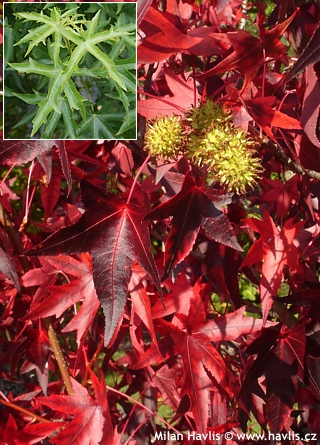
We are happy to introduce one of the most beautiful and very rare variety of sweetgum called Rotundiloba. The Latin name says it all: with rounded lobes. Its leaves show distinctly rounded lobes on 3 segments of a 5-lobed star-shaped leaves. They are deciduous, deep green, glossy, turning various sh ...
6 - 12m
4 - 7m
full sun
5b   (down to -27°C)
Code of winter protection zone 5+6
for zone 5+6
Code of winter protection zone 7
for zone 7
4468_1.jpeg
Stella is an attractive sweet gum selection, similar to Stared variety, yet a little broader in habit. Its leaves are beautiful, 15-20 cm large, deciduous, star-shaped, deeply lobed, green in summer and rich scarlet red and deep burgundy red in autumn for almost 2 months. An extra feature is the lea ...
6 - 12m
2 - 4m
full sun
5   (down to -29°C)
Code of winter protection zone 5+6
for zone 5+6
Code of winter protection zone 7
for zone 7
4418_1.jpeg
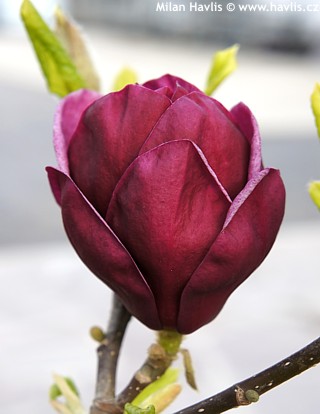
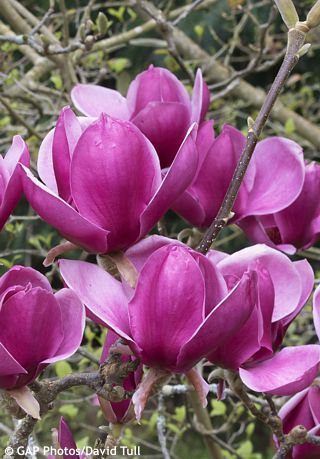
Black Beauty magnolia is another brooklynensis hybrid from the Brooklyn Botanic Gardens, USA, which, surprisingly, does not bear yellow flowers. It is a cross of m.acuminata (cucumber magnolia with yellow flowers) and m.liliiflora (lily magnolia with rosy red flowers). It produces 10-20 cm tall, ere ...
IV
3 - 6m
2 - 3m
full to partial sun
5   (down to -29°C)
Code of winter protection zone 5+6
for zone 5+6
Code of winter protection zone 7
for zone 7
2974_1.jpeg
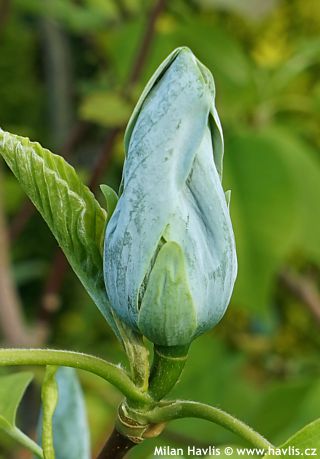
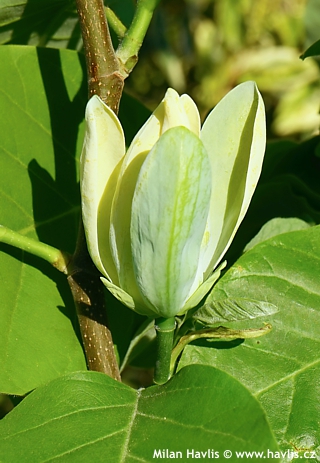
Are you a magnolia lover who thinks he has seen them all? Well, have another look at this almost blue magnolia. Of course it is slightly exaggerated, there are just blue hues in the bud, yet they are stunning. Blue Opal magnolia is a selection from magnolia acuminata (so-called cucumber magnolia) ...
V - V
3 - 6m
2 - 3m
full to partial sun
5   (down to -29°C)
Code of winter protection zone 5+6
for zone 5+6
Code of winter protection zone 7
for zone 7
157_1.jpeg
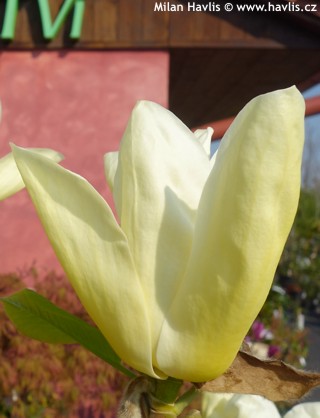
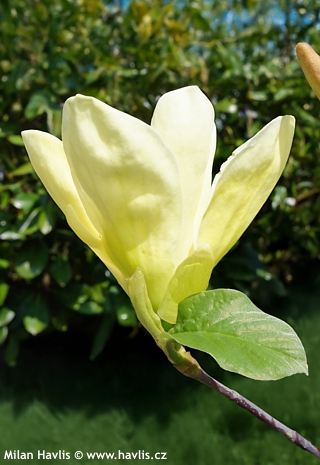
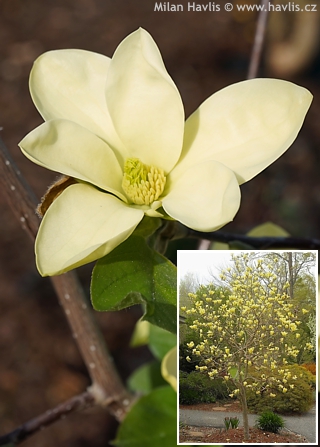
Another unique jewel among magnolias is this yellow flowering hybrid. It is a cross between m.denudata and m.acuminata (cucumber magnolia). It was raised by Phil Savage in Michigan, USA, in 1988 and patented three years later. Medium-sized flowers are unusual and truly gorgeous. The colour is clea ...
IV - V
3 - 5m
3 - 5m
full to partial sun
5   (down to -29°C)
Code of winter protection zone 5+6
for zone 5+6
Code of winter protection zone 7
for zone 7
1888_1.jpeg
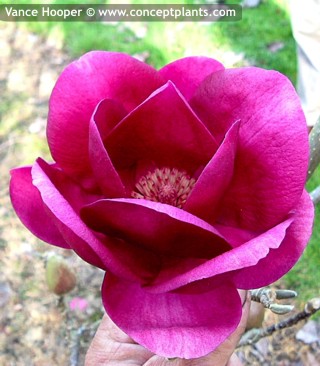
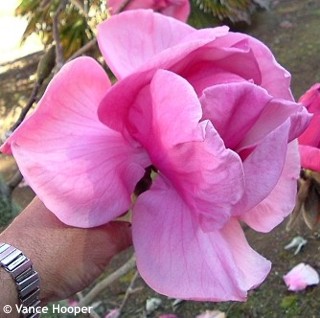
Cleopatra is another magnolia success by a renowned magnolia breeder Vance Hooper from New Zealand. It is a cross between Sweet Simplicity and Black Tulip varieties. The result is a rich purple red, large flower, almost 20 cm across with a lovely fragrance. In Central European climate it grows moder ...
IV - V
3 - 4m
2 - 3m
full to partial sun
6   (down to -23°C)
Code of winter protection zone 5+6
for zone 5+6
Code of winter protection zone 7
for zone 7
4745_1.jpeg
Coral Lake is a chameleon magnolia changing colours during flowering. It is a cross between Legend (m. acuminata x m. acuminata ssp. subcordata, 1985) and Butterflies (m. acuminata x m. denudata ‚Sawada’s Cream‘, 1988). The most interesting fact about it breeding is that neither of ...
IV - V
3 - 5m
3 - 4m
full sun
4   (down to -34°C)
Code of winter protection zone 5+6
for zone 5+6
Code of winter protection zone 7
for zone 7
1557_1.jpeg
Daybreak magnolia has a unique shade of pink. The flower buds are slim and tall, rich pink but not garish. They show small, flame-like triangles of green colour at the bottom of their calyxes. The buds take quite some time looking precious for many days before they open wide into fascinating, soft p ...
IV - V
3 - 5m
1,5 - 2m
full to partial sun
5   (down to -29°C)
Code of winter protection zone 5+6
for zone 5+6
Code of winter protection zone 7
for zone 7
1555_1.jpeg
Felix magnolia, also called Felix Jury, is a recent introduction by Mark Jury, and a gorgeous hybrid named after his late father who fortunately lived to see its first flowers, but not its worldwide success a few years later. It was made in 1984 as a cross between extremely large-flowered Atlas and ...
IV - V
2 - 3,5m
1,5 - 2m
full to partial sun
5b   (down to -27°C)
Code of winter protection zone 5+6
for zone 5+6
Code of winter protection zone 7
for zone 7
4721_1.jpeg
Galaxy magnolia was raised at U.S. National Arboretum in 1963, as a cross between purple-pink m. liliiflora ‚Nigra‘ and large-flowered m. sprengeri ‘Diva’. The result is a strong growing shrub or rather single-stemmed mid-sized tree with a thick leader, forming dense, oval to ...
IV - VI
3 - 6m
2 - 4m
full sun
4   (down to -34°C)
Code of winter protection zone 5+6
for zone 5+6
Code of winter protection zone 7
for zone 7
920_1.jpeg
Genie is a sensational new magnolia from New Zealand. After 15 years of breeding there is eventually a plant that holds its deep red-purple colour well and offers prolonged flowering period. The hybridizing process was truly awesome, if you are interested in how this jewel came to life follow its hi ...
V - VI
1 - 3m
1 - 3m
full to partial sun
5   (down to -29°C)
Code of winter protection zone 5+6
for zone 5+6
Code of winter protection zone 7
for zone 7
259_1.jpeg
Among deciduous magnolias there are varieties that bloom later than most of the Asian ones. This selection named Charles Coates originated in England in Kew, famous for its Kew Gardens, by crossing m.sieboldii and m.tripetala.It makes leaves first, and only at the end of spring it shows a magnificen ...
V - VI
3 - 5m
1,5 - 2,5m
full to partial sun
5b   (down to -27°C)
Code of winter protection zone 5+6
for zone 5+6
Code of winter protection zone 7
for zone 7
5850_1.jpeg
Judith D. Zuk (1951-2007) was an American horticulturist and conservationist, a graduate of the prestigious Rutgers University, where many beautiful plants are bred, several of which have reached us, too. From 1990 to 2005, she served as president of the Brooklyn Botanic Garden, and during her tenur ...
IV - V
4 - 7m
1,5 - 2,5m
full to partial sun
5   (down to -29°C)
Code of winter protection zone 5+6
for zone 5+6
Code of winter protection zone 7
for zone 7
4718_1.jpeg
Livingstone magnolia is a cross between m. sprengeri ‘Diva’ and m. ‘Vulcan’. Sprenger’s magnolia is often used in hybridization for flower size and fragrance, and Vulcan was surely chosen for the colour. The result is splendid. A large flower of a vibrant purple red col ...
IV - V
4 - 6m
1,5 - 3m
full to partial sun
5b   (down to -27°C)
Code of winter protection zone 5+6
for zone 5+6
Code of winter protection zone 7
for zone 7
4715_1.jpeg
Maxine Merrill is a magnolia cross between m.acuminata ssp. subcordata ‚Miss Honeybee‘ and m. x loebneri ‚Merrill‘. It was bred by one of the greatest magnolia breeders Phil Savage from the USA. It produces medium-sized, cup-shaped flowers with 6 sturdy petals of soft banana ...
IV - V
4 - 5m
2 - 3m
full to partial sun
5   (down to -29°C)
Code of winter protection zone 5+6
for zone 5+6
Code of winter protection zone 7
for zone 7
5852_1.jpeg
Olivia magnolia was developed by August Kehr as a hybrid between the varieties Miss Honeybee and Gold Crown, and in 2003, two years after his death, it was selected and named by Koen Camelbeke and Philippe de Spoelberch from the Belgian Arboretum Wespelaar. It bears medium-sized flowers with a span ...
IV - V
3 - 5m
2 - 3m
full to partial sun
5   (down to -29°C)
Code of winter protection zone 5+6
for zone 5+6
Code of winter protection zone 7
for zone 7
5849_1.jpeg
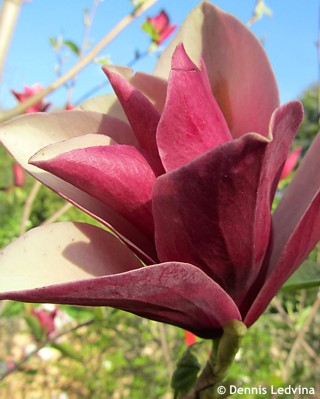
Pink Charm is a pink-flowered and highly attractive magnolia variety that, along with Rose Marie, emerged from the crossing of Pink Surprise and Daybreak. It was bred and introduced by Dennis Ledvina in 2013. The flowers are bright pink on the outside, pale pink to almost white on the inside, and ha ...
IV - V
3 - 6m
2 - 3m
full to partial sun
5   (down to -29°C)
Code of winter protection zone 5+6
for zone 5+6
Code of winter protection zone 7
for zone 7
5738_1.jpeg
Purple Star magnolia is a modern variety from 2015 from the renowned Belgian breeder Phillippe de Spoleberch, whose perhaps the greatest success, with which he gained fame around the world, is Daphne magnolia, so far considered the best deep yellow available. Purple Star is a cross between m. cylind ...
IV - V
3 - 6m
2 - 3m
full to partial sun
6   (down to -23°C)
Code of winter protection zone 5+6
for zone 5+6
Code of winter protection zone 7
for zone 7
3117_1.jpeg
Shirazz (two zeds) is a lush magnolia variety from New Zealand. It is a cross between magnolia denudata and magnolia Vulcan. The result is a profusion of vibrant claret red flowers with paler interior. They are fragrant and come out along strictly upright branches like closed tulips, opening wide a ...
IV - IV
3 - 5m
1,5 - 2m
full to partial sun
5   (down to -29°C)
Code of winter protection zone 5+6
for zone 5+6
Code of winter protection zone 7
for zone 7
4420_1.jpeg
Sunsation magnolia belongs among yellow flowering hybrids, yet it has two more colours to offer: pink and green. Inner petals have a purple pink flame at the base changing to a pink stripe across the midrib. And outer petals are chartreuse before the flower opens completely. It is a cross between tw ...
IV - V
3 - 4m
1,5 - 2m
full to partial sun
4   (down to -34°C)
Code of winter protection zone 5+6
for zone 5+6
Code of winter protection zone 7
for zone 7
1097_1.jpeg
Another jewel among magnolias came from New Zealand, again, and was raised by Mark Jury. Its name is Black Tulip® and has been sought after thanks to its very deep purple colour of flowers. They are rich purple in colour, not too large – only about 10-15 cm across, goblet-shaped making a ...
V - V
3 - 5m
1 - 2m
full to partial sun
5   (down to -29°C)
Code of winter protection zone 5+6
for zone 5+6
Code of winter protection zone 7
for zone 7
5851_1.jpeg
Red As magnolia (sometimes referred to as Red As Red) by Ian Baldick is a hybrid between the varieties Pickard’s Ruby and Vulcan and has been on the market since 2004. It produces stunning, chalice-shaped flowers of a deep purple-red colour especially on the outside, and a tone paler inside, a ...
IV - V
3 - 4m
2 - 3m
full to partial sun
6   (down to -23°C)
Code of winter protection zone 5+6
for zone 5+6
Code of winter protection zone 7
for zone 7
4751_1.jpeg
Golden Gift is a magnolia crossing between m. acuminata ‘Miss Honeybee’ and (m. acuminata x m. denudate) which makes it obvious that thanks to a lot of genes of cucumber magnolia (m. acuminata) the flowers should be yellow. And they are! They are 6-petalled, mid-sized, tulip-shaped, soft ...
IV - V
3 - 4m
2 - 3m
full to partial sun
5   (down to -29°C)
Code of winter protection zone 5+6
for zone 5+6
Code of winter protection zone 7
for zone 7
3571_1.jpeg
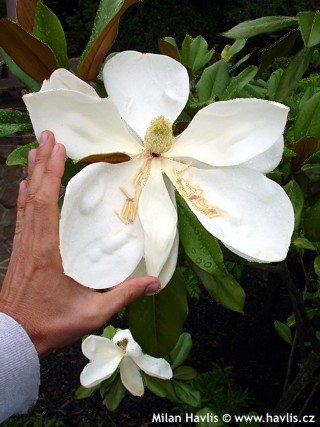
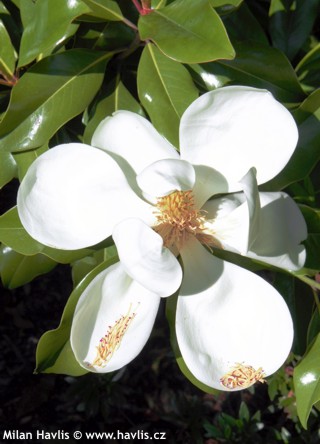
Ferruginea is a southern magnolia variety with large, 24-26 cm across, creamy white, lotus-like flowers whose fragrance attracts not only bees and other insects, but also most perfume producers and every passer-by, especially in late afternoon and early evening when it releases its rich, sweet and c ...
VI - IX
4 - 8m
3 - 5m
full sun
6   (down to -23°C)
Code of winter protection zone 5+6
for zone 5+6
Code of winter protection zone 7
for zone 7
1264_1.jpeg
Francois Treyve evergreen magnolia is more compact than the species. It bears deep green, glossy, broadly ovate or almost rounded leaves with cinnamon-brown leathery undersides that protect them from drying winds and cold. Flowers appear from the first hot and sunny days of summer. They are beautifu ...
VII - VIII
3 - 6m
2 - 3m
full sun
6   (down to -23°C)
Code of winter protection zone 5+6
for zone 5+6
Code of winter protection zone 7
for zone 7
309_1.jpeg
Goliath is bushier than the species. As you can tell by its name, something is going to be extraordinary here. True: the flowers are extremely large, often up to 30 cm wide, strongly fragrant and appear on the plant usually from June, often from late May if the end of spring is hot, and continue blo ...
V - IX
3 - 8m
3 - 4m
full sun
6   (down to -23°C)
Code of winter protection zone 5+6
for zone 5+6
Code of winter protection zone 7
for zone 7
310_1.jpeg
Little Gem is an evergreen magnolia which is smaller in every aspect but offers more of everything. The glossy, leathery leaves are numerous, making the plant very dense. They are deep green with distinct rusty underneath. When crushed they release a fine resin perfume. The amount of creamy white, ...
VI - X
2 - 4m
1,5 - 2,5m
full sun
6b   (down to -21°C)
Code of winter protection zone 5+6
for zone 5+6
Code of winter protection zone 7
for zone 7
3994_1.jpeg
Southern magnolia Twenty Four Below is next to Edith Bogue variety one of the two hardiest evergreen magnolias known to trade. It produces large, 24-28 cm across, creamy white, lotus-like, and fragrant flowers from July until September. Their scent attracts not only bees and other insects, but also ...
VII - IX
4 - 8m
3 - 5m
full sun
5   (down to -29°C)
Code of winter protection zone 5+6
for zone 5+6
Code of winter protection zone 7
for zone 7
3245_1.jpeg
Bracken’s Brown Beauty, commonly shortened to BBB, is one of the hardiest and reliable southern magnolias. It was selected as a chance seedling by Ray Bracken in his nursery in Easley in South Carolina, USA, in 1968. Further 15 years of vegetative propagation confirmed stable behaviour so in 1 ...
VI - IX
4 - 8m
3 - 5m
full sun
5b   (down to -27°C)
Code of winter protection zone 5+6
for zone 5+6
Code of winter protection zone 7
for zone 7
88_1.jpeg
This variety received its name after a French governor in Canada in 18 century, and has been in cultivation in France for more than 150 years. It is very popular in Britain, too, where it is considered fully hardy. And Italy, namely Tuscany, would most definitely lose its most spectacular symbol wit ...
VI - VII
3 - 8m
2 - 4m
full sun
7   (down to -18°C)
Code of winter protection zone 5+6
for zone 5+6
Code of winter protection zone 7
for zone 7
1534_1.jpeg
ALTA® is a gorgeous southern magnolia of dense habit and narrowly columnar, very elegant shape that looks like a candle flame. From the first hot days of summer large – 20-24 cm across, creamy white, strongly sweet-scented flowers are produced singly and continuously for 2 months or a little longer ...
VII - VIII
3 - 6m
1 - 2m
full sun
6   (down to -23°C)
Code of winter protection zone 5+6
for zone 5+6
Code of winter protection zone 7
for zone 7
5737_1.jpeg
Discovering magnolia STARBURST was a thrill. Not only has it gorgeous flowers, but it also has something very practical for small gardens – narrower, almost fastigiate habit. Its fragrant flowers are 15-20 cm across, purple red on the outside and much paler inside with pink stars airbrushed on ...
IV - V
2 - 4m
1 - 2m
full to partial sun
6   (down to -23°C)
Code of winter protection zone 5+6
for zone 5+6
Code of winter protection zone 7
for zone 7
552_1.jpeg
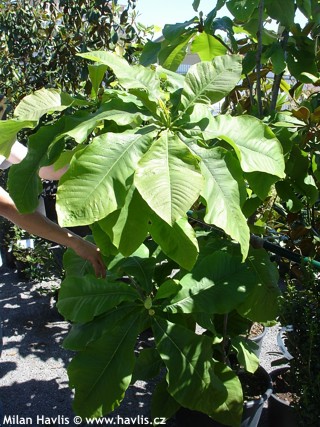
Umbrella magnolia is a unique plant of its species. It is quite unusual though easy to grow. Its main feature are exotic-looking, large leaves that can grow 30-45 cm long. Their colour is mid-green flashed with bronze from spring to early summer. They are soft and slightly hairy beneath, crowded at ...
V - VI
6 - 10m
full to partial sun
5   (down to -29°C)
Code of winter protection zone 5+6
for zone 5+6
Code of winter protection zone 7
for zone 7
4717_1.jpeg
Hattie Carthan magnolia was bred by Doris Stone from the Brooklyn Botanic Garden by cross-pollinating several unnamed m. x brooklynensis hybrids (m.acuminata x magnolia x liliiflora) and ‘Evamaria’ variety. The result was a stunning magnolia with firm flowers of elongated tepals. They ar ...
IV - V
4 - 7m
1,5 - 3m
full to partial sun
5   (down to -29°C)
Code of winter protection zone 5+6
for zone 5+6
Code of winter protection zone 7
for zone 7
5853_1.jpeg
Woodsman is more than a lumberjack. In a broader sense, he's also someone who takes care of the forest and its trees, not seeing them as a commodity. He loves and appreciates them. People connected with occupations such as woodsman or lumberjack are often described in a manly manner which nowadays ...
V
2 - 4m
1,5 - 2,5m
full to partial sun
5   (down to -29°C)
Code of winter protection zone 5+6
for zone 5+6
Code of winter protection zone 7
for zone 7
513_1.jpeg
“Yellow Bird” magnolia is a cross between magnolia acuminata and magnolia brooklynensis “Evamaria” from 1967. Yet that year it was suggested the best yellow cultivar so far. Well, a lot of time has passed and these days there are a few more girls to ask that honour that we co ...
V - V
3 - 6m
full to partial sun
5   (down to -29°C)
Code of winter protection zone 5+6
for zone 5+6
Code of winter protection zone 7
for zone 7
4754_1.jpeg
Proctor magnolia is a hybrid of two Japanese magnolia species – m. stellata and m. salicifolia. It is distinguished by early flowering and profusion of star-shaped, white, fragrant flowers, larger than on m. stellata, with less petals but of firmer appearance. Slavin’s Snowy is a selecti ...
III - IV
6 - 8m
3 - 4m
full to partial sun
5   (down to -29°C)
Code of winter protection zone 5+6
for zone 5+6
Code of winter protection zone 7
for zone 7
261_1.jpeg
It was in 1826 when the very first bloom of this famous saucer magnolia came into the world. It was bred by French botanist Etienne Soulange-Bodin who 6 years before that success made a cross between m.denudata and m.liliflora. It blooms on bare branches with beautifully scented, goblet- or saucer ...
IV - V
4 - 8m
full to partial sun
5   (down to -29°C)
Code of winter protection zone 5+6
for zone 5+6
Code of winter protection zone 7
for zone 7
2201_1.jpeg
If you are a magnolia lover who still has some space in the garden which is a rare combination, have a look at this immense beauty in white named Alba Superba. It is a reliable and hardy variety of saucer magnolia. If the weather is nice, from mid April (in zone 6) begins to open its profusion of me ...
IV - V
4 - 6m
3 - 4m
full to partial sun
5   (down to -29°C)
Code of winter protection zone 5+6
for zone 5+6
Code of winter protection zone 7
for zone 7
262_1.jpeg
Based on the successful crossing of saucer magnolia a new variety was bred at the end of the 19th centutry. Its name is Rustica Rubra or just Rubra and comes from the nursery town Boskoop in the Netherlands. The beautifully scented flowers are goblet- to saucer-shaped, bright purplish red outsid ...
IV - V
4 - 8m
3 - 5m
semi-shade / partial sun
5   (down to -29°C)
Code of winter protection zone 5+6
for zone 5+6
Code of winter protection zone 7
for zone 7
5735_1.jpeg
Superba is a saucer magnolia variety which differs from the original hybrid in slightly paler flowers with longer petals, later onset of flowering and a more subtle habit. The flowers are approx. 10 cm high and up to 20 cm wide when fully opened, and the individual petals are narrower and not as con ...
IV
4 - 6m
3 - 4m
full to partial sun
5   (down to -29°C)
Code of winter protection zone 5+6
for zone 5+6
Code of winter protection zone 7
for zone 7
4720_1.jpeg
Thompson magnolia boasts large, creamy white, very fragrant flowers which come out from June until July on a fully leafed out plant. The flowers are up to 15 cm across and the fragrance is deep and sweet. Deciduous leaves are broadly ovate to obovate, 15-25 cm long, fresh green above and glaucous be ...
VI - VII
3 - 5m
2 - 3m
full sun
6   (down to -23°C)
Code of winter protection zone 5+6
for zone 5+6
Code of winter protection zone 7
for zone 7
37_1.jpeg
First time introduced in 1954, this grape holly has been commercially spread at the turn of the century. Its dramatic foliage makes it as successful in continental climates as palm trees in the coastal areas. The leaves are holly-like but gigantic, arranged in spectacular rosettes. These are very co ...
XII - III
1,5 - 3m
1 - 2m
semi-shade to shade
7   (down to -18°C)
Code of winter protection zone 5+6
for zone 5+6
Code of winter protection zone 7
for zone 7
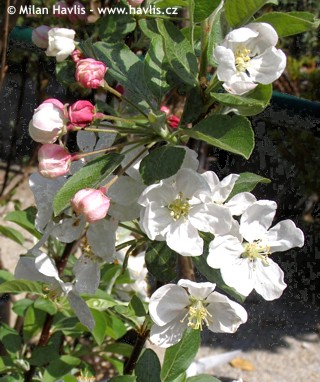
823_1.jpeg
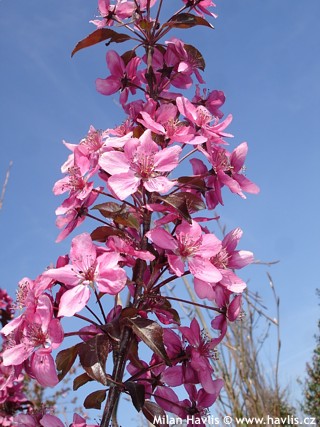
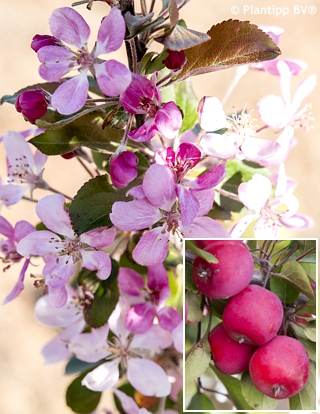
Profusion crab apple is a hybrid, sometimes classified as malus x moerlandsii. It comes from the Netherlands. Its main feature are dark purple-pink flowers that come out from mid to end spring in profusion. They are followed by small, spherical fruit of purplish-black colour and look like wild che ...
IV - V
2 - 5m
2 - 5m
full to partial sun
4   (down to -34°C)
Code of winter protection zone 5+6
for zone 5+6
Code of winter protection zone 7
for zone 7
38_1.jpeg
This crab apple is a beautiful small tree with excellent flowering in the spring. The flowers are deep pink to bright purple and are followed by non-edible dark purple-red small fruits. The leaves are small-ish as opposed to real apple, glossy, deep burgundy red throughout the season with no conspic ...
IV - V
3 - 5m
2 - 5m
full sun
4   (down to -34°C)
Code of winter protection zone 5+6
for zone 5+6
Code of winter protection zone 7
for zone 7
647_1.jpeg
Malus Perpetu® is another crab apple. This variety offers snow-white flowers, very similar to those you can see on apple trees. They open from pink buds and their number is very high every year. Deciduous leaves are green, ovate, mid-sized. The best attraction is the fruit – many tiny app ...
IV - V
3 - 5m
2 - 3m
full to partial sun
4   (down to -34°C)
Code of winter protection zone 5+6
for zone 5+6
Code of winter protection zone 7
for zone 7
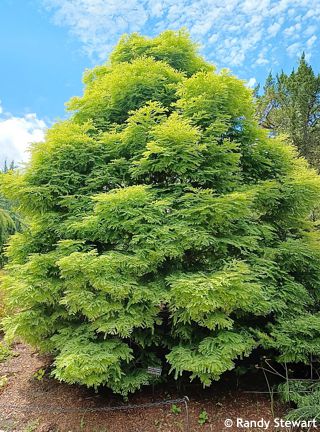
5871_1.jpeg
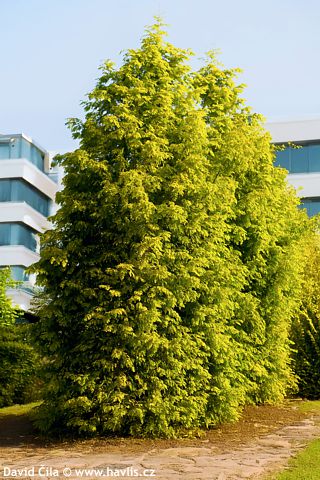
AMBER GLOW™ is the result of the breeding work of William A. Head, an American breeder from Seneca, S.C., who aimed to develop a variety of dawn redwood with golden leaves that could withstand the hot summer sun without scorching, even if it didn't have roots in constant moisture. He succeeded ...
3 - 7m
2 - 4m
full sun
4   (down to -34°C)
Code of winter protection zone 5+6
for zone 5+6
Code of winter protection zone 7
for zone 7
5807_1.jpeg
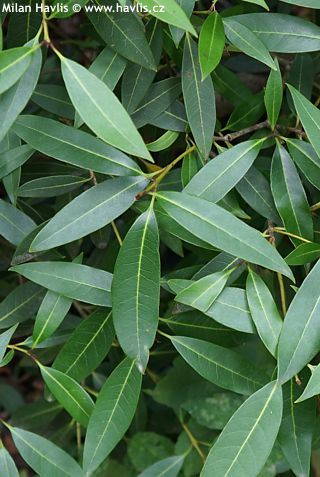
Turkey olive comes from Asia Minor where it was first found in the region of Lazistan (Turkey and partly Georgia) at the Black Sea coast. It is a warm and humid subtropical climate without winter frosts, but with enough precipitation during autumn and winter, i.e., large-leaved evergreen trees thriv ...
IV - V
2 - 4m
2 - 3m
full to partial sun
6b   (down to -21°C)
Code of winter protection zone 5+6
for zone 5+6
Code of winter protection zone 7
for zone 7
Osmanthus serrulatus vonokvětka pilovitá
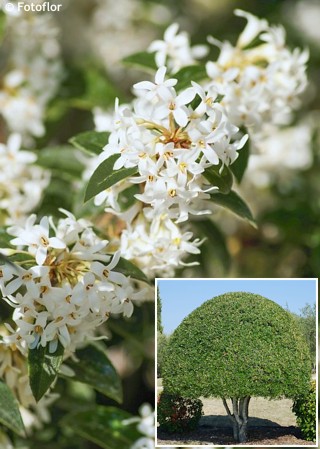
Saw-toothed sweet olive is one of the most fragrant members of its genus – its small, white flowers can fill the mountain air of western China with a sweet, jasmine-like scent that travels far beyond its modest appearance. This species originates from Sichuan province, where it grows at elevations a ...
IX - X
1,5 - 3m
1,5 - 3m
full to partial sun
7   (down to -18°C)
Code of winter protection zone 5+6
for zone 5+6
Code of winter protection zone 7
for zone 7
4195_1.jpeg
Burkwood's sweet olive is a garden hybrid between Chinese osmanthus delavayi and Turkish osmanthus decorus. It is more beautiful and tougher than either of its parents. It boasts dense habit, profuse flowering, and handsome foliage. Evergreen leaves are leathery, ovate, 3-5 cm long, medium green, gl ...
IV - V
1,5 - 3m
1,5 - 3m
full to partial sun
6   (down to -23°C)
Code of winter protection zone 5+6
for zone 5+6
Code of winter protection zone 7
for zone 7
73_1.jpeg
Fortune's osmanthus is a cross between o.heterophyllus (small, very spiny leaves) and o.fragrans (large, entire leaves). It was first brought from Japan to Europe to Holland Philipp Franz von Siebold in 1856. Over the years its name has developed from osmanthus aquifolium to o.aquifolium var.latifo ...
X - XI
1,5 - 3m
1,5 - 2,5m
full to partial sun
6b   (down to -21°C)
Code of winter protection zone 5+6
for zone 5+6
Code of winter protection zone 7
for zone 7
143_1.jpeg
The Persian ironwood is a deciduous, usually multi‑stemmed tree with handsome leaves. They are smooth, glossy, broadly oval, similar to beech leaves but about twice the size: 6–15 × 4–10 cm, with pronounced veins that give them a sculptural quality. In spring they are light green, remaining fr ...
5 - 12m
4 - 6m
full to partial sun
4   (down to -34°C)
Code of winter protection zone 5+6
for zone 5+6
Code of winter protection zone 7
for zone 7
731_1.jpeg
The cultivar Vanessa belongs among the narrowly growing forms of Persian ironwood and is distinguished by attractive, broadly oval leaves with pronounced veins. In spring they are fresh green, in summer some retain reddish margins, and in autumn they transform into several layers of radiant colours ...
8 - 12m
3 - 5m
full sun
4   (down to -34°C)
Code of winter protection zone 5+6
for zone 5+6
Code of winter protection zone 7
for zone 7
Parrotia persica 'JL Columnar' PERSIAN SPIRE®
When people think of Persian ironwood, most imagine a broad, spreading tree with dazzling autumn colours. ‘Vanessa’ once showed that it could grow more narrowly, but with age it widens and loses its slender form. PERSIAN SPIRE® plays in a different league – it was chosen from the very beginning for ...
6 - 9m
1,5 - 2,5m
full sun
4   (down to -34°C)
Code of winter protection zone 5+6
for zone 5+6
Code of winter protection zone 7
for zone 7
4888_1.jpeg
Narrow-leaved mock privet is another typical plant of so-called macchia vegetation found in dry and hot, rocky slopes of South Europe, i.e. plants which cope extremely well with long-lasting drought and are usually unattacked by wild animals. This mock privet has narrowly elliptic to lance-shaped, 4 ...
2 - 3m
2 - 3m
full sun
6   (down to -23°C)
Code of winter protection zone 5+6
for zone 5+6
Code of winter protection zone 7
for zone 7
Phillyrea angustifolia f. ROSMARINIFOLIA
Fancy a delicate, airy feel? Then you will surely fall for this selection of mock privet called rosmarinifolia. Although now rather rare in cultivation, it is by no means a newcomer. No one knows exactly who or when it was first found in the wild, but we do know that the English botanist Philip Mill ...
2 - 3m
2 - 3m
full sun
6   (down to -23°C)
Code of winter protection zone 5+6
for zone 5+6
Code of winter protection zone 7
for zone 7
Phillyrea angustifolia 'GREEN UP'
The cultivar Green Up represents narrow-leaved mock privet in its most disciplined form. At first glance it impresses with its exceptionally regular, upright, and dense growth, which appears calm, solid, and very contemporary. Compared to the botanical species, it grows more slowly and forms a compa ...
1,5 - 2,5m
2 - 3m
full to partial sun
6   (down to -23°C)
Code of winter protection zone 5+6
for zone 5+6
Code of winter protection zone 7
for zone 7
Phillyrea latifolia
Large-leaved mock privet is a low, very bushy evergreen tree with such a picturesque, dense crown that it has earned the English nicknames broccoli tree or green olive tree. Its leaves are opposite, broadly elliptic to ovate, typically 3–6 cm long, very stiff and leathery, with a glossy, dark g ...
4 - 10m
3 - 6m
full sun
6   (down to -23°C)
Code of winter protection zone 5+6
for zone 5+6
Code of winter protection zone 7
for zone 7
1014_1.jpeg
David's photinia / Chinese stranvaeasia is an evergreen shrub whose close relative is a garden hybrid photinia Red Robin. It comes from China and Vietnam and has better cold resistance and narrower leaves. They are deep green and glossy but emerge dark burgundy red in the spring. Before autumn some ...
V - VI
1,5 - 4m
1,5 - 3m
full sun
5b   (down to -27°C)
Code of winter protection zone 5+6
for zone 5+6
Code of winter protection zone 7
for zone 7
5052_1.jpeg
Taiwanese photinia is renowned for notably narrower leaves as opposed to Chinese photinia. Those are deep green, narrowly lance-shaped, and glossy. They emerge coppery red in spring, and in autumn many of older leaves turn scarlet red or light maroon, some plants may gain these shades all over. It ...
VI
1,5 - 4m
1,5 - 4m
full to partial sun
6   (down to -23°C)
Code of winter protection zone 5+6
for zone 5+6
Code of winter protection zone 7
for zone 7
1320_1.jpeg
Camilvy photinia is Europe’s answer to the famous New Zealand cultivar ‘Red Robin’. It originates from the Netherlands, where it was bred by Peter Van Lieshout (Venhorst, NL) and named after his two daughters, Camily and Ilvy. He never patented it nor published detailed information about its or ...
V
2 - 4m
2 - 4m
full to partial sun
6   (down to -23°C)
Code of winter protection zone 5+6
for zone 5+6
Code of winter protection zone 7
for zone 7
41_1.jpeg
Red Robin is the very first and, it must be said, still a remarkably successful cultivar of Fraser's photinia. Twenty years after its introduction it received the AGM (Award of Garden Merit) from the Royal Horticultural Society for its resilience, beauty and reliability. It is a New Zealand selecti ...
V
2 - 5m
1 - 4m
full to partial sun
6   (down to -23°C)
Code of winter protection zone 5+6
for zone 5+6
Code of winter protection zone 7
for zone 7
1494_1.jpeg
This photinia was originally named Cassini, a very charming name, but the commercial world insisted on a new designation: PINK MARBLE®. It must be said that it is fits – this evergreen shrub bears ovate leaves intricately threaded with white and silvery tones that turn distinctly pink towards the en ...
2 - 4m
2 - 4m
full to partial sun
6   (down to -23°C)
Code of winter protection zone 5+6
for zone 5+6
Code of winter protection zone 7
for zone 7
3237_1.jpeg
From the very moment CARRÉ ROUGE photinia hit the market, it became an overnight sensation. It originates from the hugely successful ‘Red Robin’, but offers a far more compact and denser habit, with smaller leaves that look elegant and completely smother the plant’s coat, turning the photinia into a ...
2 - 3m
1 - 2m
full to partial sun
6   (down to -23°C)
Code of winter protection zone 5+6
for zone 5+6
Code of winter protection zone 7
for zone 7
3699_1.jpeg
RED LIGHT is a Dutch selection of the popular photinia, introduced in 2013 by its breeder Alexander van Oploo. The cultivar is protected under European patent EU32555 and immediately catches the eye with the brilliant red colour of its young shoots. In spring it produces deep wine‑red new leav ...
IV
1,5 - 2,5m
1,5 - 2m
full to partial sun
6   (down to -23°C)
Code of winter protection zone 5+6
for zone 5+6
Code of winter protection zone 7
for zone 7
2156_1.jpeg
Acrocona is a beauty among Norway spruces. It is a smaller variety with picturesque cones at the tips of the branches. They are small, rich raspberry red and appear from May. Later they turn brown as they mature. Needles are medium short, deep green, and prickly. The habit is somewhat narrowly con ...
V - VI
3 - 5m
3 - 4m
full sun
3   (down to -40°C)
Code of winter protection zone 5+6
for zone 5+6
Code of winter protection zone 7
for zone 7
1446_1.jpeg
The word that most conifer lovers are likely to think of when they first see Brewer spruce is graceful. No wonder, because its long, frilled streamers of branchlets cascading from the scaffold branches turn the tree into a living waterfall. The habit is narrowly conical to columnar in youth, gradual ...
8 - 15m
4 - 6m
full sun
5   (down to -29°C)
Code of winter protection zone 5+6
for zone 5+6
Code of winter protection zone 7
for zone 7
3880_1.jpeg
Compacta Glauca is an arolla pine variety of reduced size. It was selected by C.Frets & Son nursery in Boskoop, the Netherlands, around 1930, in a field of older variety called Glauca which had been known since 1860's. It exhibits much denser and congested growth, and produces about 10 cm long needl ...
3 - 5m
1 - 1,5m
full sun
4   (down to -34°C)
Code of winter protection zone 5+6
for zone 5+6
Code of winter protection zone 7
for zone 7
1825_1.jpeg
Rocky Mountains white pine is a North American pine species whose origin ranges through the Rocky Mountains of Alberta in Canada down to Colorado, USA. It has distinctively flexible young twigs and soft, blue-green to silvery-blue needles. Female cones are yellow-brown, 8-15 cm long, and are borne a ...
5 - 9m
1 - 2,5m
full sun
4   (down to -34°C)
Code of winter protection zone 5+6
for zone 5+6
Code of winter protection zone 7
for zone 7
1459_1.jpeg
Pine trees are superb trees which grow in a wide climate scale - from cold northern countries to hot coastal sites. They are probably most beautiful in their natural environment. Satellit is a narrowly columnar variety of Bosnian pine. Thanks to slow growth and limited size it is suitable for smal ...
3 - 6m
1 - 1,5m
full sun
5   (down to -29°C)
Code of winter protection zone 5+6
for zone 5+6
Code of winter protection zone 7
for zone 7
587_1.jpeg
Ammerland is a very decorative, medium-sized western pine. These pines come from western parts of North America but this variety was bred in German Jeddeloh. Its needles are borne in whorls of 5. They are mostly erect, stiff, blue-green, long. The shape of this pine is rather conical, looking bett ...
3 - 5m
full sun
5   (down to -29°C)
Code of winter protection zone 5+6
for zone 5+6
Code of winter protection zone 7
for zone 7
3872_1.jpeg
Oregon Green is a very beautiful addition to the family of small to mid-sized pine trees. It was found as a seedling by Morris Van Meter in his nursery in Boring, Oregon, USA, in early 1990's. It is easily distinguished by its stiff habit with erect branches where needles are borne in such density a ...
4 - 6m
3 - 4m
full sun
4   (down to -34°C)
Code of winter protection zone 5+6
for zone 5+6
Code of winter protection zone 7
for zone 7
4020_1.jpeg
Moseri is a dwarf variety of Scots Pine from Moser Nursery in Versailles, France, from 1900. It has long, slightly twisted needles of soft green colour in summer and rich golden yellow in winter. It grows very slowly (8-12 cm per year) and naturally forms dense, broadly pyramidal shrubs with rounded ...
2 - 3m
1,5 - 2,5m
full sun
3   (down to -40°C)
Code of winter protection zone 5+6
for zone 5+6
Code of winter protection zone 7
for zone 7
129_1.jpeg
Watereri is a small, slow-growing pine which is also commercially known under the name “Nana” – a typical name for many dwarf plants. Its needles are borne in pairs, dark green with only a hint of blue-green in summer, and more bluish in cold months of autumn and winter. It is very ...
2 - 4m
1 - 4m
full sun
2   (down to -45°C)
Code of winter protection zone 5+6
for zone 5+6
Code of winter protection zone 7
for zone 7
Prunus domestica ssp. syriaca 'MIRABELLE RUBY'
Mirabelle Ruby is a nearly columnar variety of mirabelle that grows tall and slender, as if reaching for the sky. It reaches a height of about 2.5 to 3 meters while maintaining a compact width of under one meter. The tree produces few lateral branches – its fruits grow directly from the trunk and ma ...
2,5 - 3m
1 - 1,5m
full sun
5   (down to -29°C)
Code of winter protection zone 5+6
for zone 5+6
Code of winter protection zone 7
for zone 7
Prunus laurocerasus 'CAUCASICA'
Caucasica cherry laurel belongs to a group of cultivars that seem to have been with us forever. They are pioneers from the golden rush of cherry laurels, the first to succeed and earn lasting recognition. Not only were they among the most attractive of their time, they also proved themselves where o ...
IV - V
3 - 5m
2 - 3m
full to partial sun
6   (down to -23°C)
Code of winter protection zone 5+6
for zone 5+6
Code of winter protection zone 7
for zone 7
462_1.jpeg
Cherry laurel Novita became a sensation the very moment it hit the market – a true horticultural blockbuster. Its dark, intensely glossy leaves looked luxurious and were impossible not to fall in love with. On top of that, it grew strongly and vigorously, quickly finding its place wherever ...
V - V
3 - 6m
2 - 5m
full sun to shade
5b   (down to -27°C)
Code of winter protection zone 5+6
for zone 5+6
Code of winter protection zone 7
for zone 7
198_1.jpeg
The Northern Irish cherry laurel selection known as ‘Castlewellan’, marketed elsewhere in Europe as Marbled White, is a true treat for lovers of variegated foliage. And by reliably variegated, we really mean it: the marbled pattern that defines the plant and captivates at first glance is stable and ...
IV - V
3 - 5m
2 - 3m
full sun to shade
6   (down to -23°C)
Code of winter protection zone 5+6
for zone 5+6
Code of winter protection zone 7
for zone 7
5505_1.jpeg
BONAPARTE® is a beautiful cherry laurel cultivar with striking copper‑coloured new growth, once again personally discovered by nurseryman Adrian Straver as a continuation of his work with cherry laurels. It thus follows the highly successful cultivar ETNA®, his first major discovery from a ...
IV
2 - 4m
1 - 2m
full to partial sun
6   (down to -23°C)
Code of winter protection zone 5+6
for zone 5+6
Code of winter protection zone 7
for zone 7
3869_1.jpeg
GENOLIA® cherry laurel originates from Switzerland, where it was selected in 2002 at the nursery Pépinières de Genolier. It is a selection of a chance seedling that not only offered a distinct appearance but also demonstrated high hardiness following an unusually severe winter. The cultivar ...
IV - V
2 - 3m
0,5 - 1m
full sun to shade
6   (down to -23°C)
Code of winter protection zone 5+6
for zone 5+6
Code of winter protection zone 7
for zone 7
326_1.jpeg
Angustifolia is a popular cultivar of Portuguese laurel, valued for its more compact growth and narrower leaves. The foliage is evergreen, leathery and firmer than that of the species, slightly incurved, narrowly elliptic, 6–10 cm long and 1.5–3 cm wide, with a striking glossy surface. The leaves de ...
V - VI
2 - 6m
2 - 4m
full to partial sun
5b   (down to -27°C)
Code of winter protection zone 5+6
for zone 5+6
Code of winter protection zone 7
for zone 7
Prunus lusitanica 'BRENELIA'
Brenelia is a modern and attractive cultivar of Portuguese laurel from France, selected by Yves Brenelière in the early 21st century. It is distinguished by its larger, distinctly undulated leaves with a higher gloss. The foliage is evergreen, narrowly elliptic, typically 8–12 cm long and 2–4 c ...
V - VI
4 - 6m
3 - 4m
full to partial sun
5b   (down to -27°C)
Code of winter protection zone 5+6
for zone 5+6
Code of winter protection zone 7
for zone 7
Prunus lusitanica 'VARIEGATA'
Variegata is a collective name for variegated forms of Portuguese laurel, and it must be acknowledged that, although they remain relatively scarce, they are more than precious collectibles. Their principal ornamental feature lies in the evergreen, leathery leaves with creamy to whitish variegation, ...
V - VI
2 - 4m
2 - 3m
full to partial sun
6   (down to -23°C)
Code of winter protection zone 5+6
for zone 5+6
Code of winter protection zone 7
for zone 7
378_1.jpeg
Colorata is a Swedish variety of European bird cherry from 1953 variety producing pink flowers and coloured foliage. In late April appear slender racemes composed of tiny, cotton-candy pink, scented flowers. Deciduous leaves are narrowly obovate, very dark green and emerge tinged an attractive tone ...
IV - V
5 - 8m
4 - 5m
full to partial sun
3   (down to -40°C)
Code of winter protection zone 5+6
for zone 5+6
Code of winter protection zone 7
for zone 7
Prunus Pluot® 'FLAVOR SUPREME'®
Pluot® Flavor Supreme® has truly earned its name – and wears it with pride, as its flavour ranks among the most intense of all pluots. The fruit features a velvety dark red to burgundy skin with a soft bloom, resembling a plum dressed for a gala. Its flesh is deep red, exceptionally juicy, with ...
2 - 3m
1 - 2m
full sun
5   (down to -29°C)
Code of winter protection zone 5+6
for zone 5+6
Code of winter protection zone 7
for zone 7
Prunus Pluot® 'PURPLE CANDY'®
Pluot® Purple Candy® looks as if in the middle of the night it secretly escaped from a tree of purple plums and caught stardust on its skin. Its fruits have a rich purple skin with a gentle sheen, reminiscent of a candy wrapped in fruit syrup. The flesh is bright carmine red, exceptionally juicy, wi ...
2 - 3m
1 - 2m
full sun
5   (down to -29°C)
Code of winter protection zone 5+6
for zone 5+6
Code of winter protection zone 7
for zone 7
53_1.jpeg
Spring in the garden is announced by flowering Japanese cherries. Amanogawa is a fantastic variety with narrowly columnar growth. In early spring it produces masses of double or semi-double, light pink flowers that may turn to clear white later. Young leaves are bronze, changing to green in summer, ...
IV - V
4 - 7m
0,5 - 1,5m
full to partial sun
5   (down to -29°C)
Code of winter protection zone 5+6
for zone 5+6
Code of winter protection zone 7
for zone 7
5442_1.jpeg
Holm oakis a natural species, not a hybrid despite two specific names in its Latin title. Integrifolia is one of its few selections first described in 1836. Its evergreen, leathery leaves are spineless with less conspicuous notches or serration at margins, often with none whatsoever. They are 3-6 cm ...
4 - 10m
3 - 6m
full sun
6   (down to -23°C)
Code of winter protection zone 5+6
for zone 5+6
Code of winter protection zone 7
for zone 7
1826_1.jpeg
It is always so nice to learn about a new plant that represents a smaller version of a large species just because many of us want to enjoy its features without having to fear that it will take up the whole of our garden. GREEN PILLAR® is one of them. It is a narrowly columnar variety of pin oak ...
7 - 15m
1 - 3m
full sun
4   (down to -34°C)
Code of winter protection zone 5+6
for zone 5+6
Code of winter protection zone 7
for zone 7
854_1.jpeg
Pseudoturneri is a later variety of Turners oak. Its leaves are very similar to common oak, mid green, shallowly lobed and partly glossy. Compared to its hybrid parent it is a little smaller, hardier, and holds its leaves more reliably over the winter. Still, some leaves may fall down at the end of ...
3 - 6m
2 - 4m
full sun
6   (down to -23°C)
Code of winter protection zone 5+6
for zone 5+6
Code of winter protection zone 7
for zone 7
5854_1.jpeg
Argenteovariegata buckthorn is an evergreen, fast-growing shrub with reliably variegated leaves. They are oval to ovate, alternate, dark green with silver-grey spots and distinct creamy white edges. They are small, only about 3-4 cm long, and densely arranged around the deep mahogany-red branches. I ...
3 - 5m
2 - 3m
full sun
6b   (down to -21°C)
Code of winter protection zone 5+6
for zone 5+6
Code of winter protection zone 7
for zone 7
289_1.jpeg
Cunningham's White is probably the best known white flowering rhododendron hybrid. The upper petal is decorated with multicoloured flare – grading from yellow, green, and brown to deep red. Prolific, year-to-year bloomer. For richer flowering and growth dead-head where possible. Rhododendrons ...
IV - V
1,5 - 3m
1,5 - 3m
full to partial sun
6   (down to -23°C)
Code of winter protection zone 5+6
for zone 5+6
Code of winter protection zone 7
for zone 7
5122_1.jpeg
Perennial Blue is a fast-growing rambling rose from 2003 bred by Bernard F. Mehring in his company Eurosa in England, and now is offered by Rosen Tantau. It is a cross between Super Excelsa and Veilchenblau. It makes rich clusters composed of small, 3-4 cm across, semi-double flowers of a unique col ...
VI - IX
2,5 - 3m
0,5 - 1m
full sun
5b   (down to -27°C)
Code of winter protection zone 5+6
for zone 5+6
Code of winter protection zone 7
for zone 7
Rosa hugonis
Father Hugo’s Rose belongs to the group of botanical roses with fine, delicate leaflets. It was first described by British botanist William Botting Hemsley at the end of the 19th century. The species was named after Scottish missionary and plant collector Reverend William Hugo, who discovered it in ...
IV - V
2 - 3m
2 - 3m
full sun
5   (down to -29°C)
Code of winter protection zone 5+6
for zone 5+6
Code of winter protection zone 7
for zone 7
3672_1.jpeg
Thundercloud is another dark-leaved variety of European elder. It is a sport of Guincho Purple from 1997 producing attractive purple red, almost purple black, deciduous leaves, and numerous flowers on young plants. They are formed in flattened panicles, open from rich purple pink buds to soft cotton ...
V - VI
2 - 3m
2 - 2,5m
full to partial sun
4   (down to -34°C)
Code of winter protection zone 5+6
for zone 5+6
Code of winter protection zone 7
for zone 7
3673_1.jpeg
GOLDEN TOWER is a slender growing variety of European elder, a sister variety of BLACK TOWER, but this time with golden foliage. Its deciduous leaves emerge bright lime green and reach a vivid yellow green or almost golden yellow shade in full sun. They are deeply incised and perfectly soften the st ...
V - VI
1 - 3m
0,5 - 1m
full to partial sun
5   (down to -29°C)
Code of winter protection zone 5+6
for zone 5+6
Code of winter protection zone 7
for zone 7
Sciadopitys verticillata
The needles of Japanese umbrella pine are distinctive: soft, almost fleshy, flexible, 5–12 cm long, deep green, and strikingly glossy. Botanically, they are not true needles, but unusual leaf‑like structures formed by the fusion of two needles, a fact confirmed by their internal anatomy. They ...
3 - 6m
2 - 4m
full to partial sun
5   (down to -29°C)
Code of winter protection zone 5+6
for zone 5+6
Code of winter protection zone 7
for zone 7
1907_1.jpeg
Winter Gold Japanese pagoda tree is a novelty brought by the new millennium. It produces vibrant shades of lemon yellow new leaves, and is decorated with rich golden yellow colour or twigs and branches in winter. The pinnate leaves are deciduous, individual leaflets are small, elliptic, and emerge ...
2 - 4m
2 - 4m
full to partial sun
5b   (down to -27°C)
Code of winter protection zone 5+6
for zone 5+6
Code of winter protection zone 7
for zone 7
Sorbaria fallax 'BURKA'
Burka is a unique hybrid rowan, growing to a height of around 3–5 meters, making it ideal for smaller gardens. Its habit is compact, with a naturally shaped, dense crown. Flowers appear from April to May, white and arranged in corymbs, attracting pollinators with their gentle fragrance. But the real ...
V - VI
3 - 5m
3 - 4m
full to partial sun
4   (down to -34°C)
Code of winter protection zone 5+6
for zone 5+6
Code of winter protection zone 7
for zone 7
400_1.jpeg
It is our utmost pleasure to offer this summer-blooming beauty: false camellia. It comes from moist woodlands of North America and eastern Asia (Japan, China, Vietnam, Nepal). It belongs to the same genus theaceae like camellia and tea. Its main attraction are the flowers. They are 6-7 cm wide, pu ...
VI - VIII
4 - 6m
1 - 3m
full to partial sun
5   (down to -29°C)
Code of winter protection zone 5+6
for zone 5+6
Code of winter protection zone 7
for zone 7
327_1.jpeg
We like offering less usual plants which are beautiful and fully hardy at the same time (we are in zone 6). This Japanese snowbell is one of them. It is a graceful, spreading, deciduous tree with almost horizontal branches that form nearly a flat canopy when mature. Its main attraction are undoubt ...
VI - VI
3 - 5m
2 - 4m
full to partial sun
5   (down to -29°C)
Code of winter protection zone 5+6
for zone 5+6
Code of winter protection zone 7
for zone 7
855_1.jpeg
Pink Chimes is a rare variety of Japanese snowbell with pink, bell-shaped flowers that hang on short stalks underneath the leaved branches. Leaves are glossy, ovate to elliptic, mid to dark green, turning yellow or red in autumn. It can be pruned at the end of winter. Grow it as a specimen shrub or ...
VI - VI
3 - 5m
2 - 4m
full to partial sun
5   (down to -29°C)
Code of winter protection zone 5+6
for zone 5+6
Code of winter protection zone 7
for zone 7
5874_1.jpeg
Ivory Silk is a profusely blooming variety of Japanese lilac, which, due to the shape of its inflorescence, can at first glance resemble crape myrtle – Lagerstroemia. The flowers are ivory cream to slightly yellowish at full maturity, strongly and sweetly fragrant, and arranged in slightly inc ...
VI
4 - 7m
3 - 5m
full sun
3   (down to -40°C)
Code of winter protection zone 5+6
for zone 5+6
Code of winter protection zone 7
for zone 7
1500_1.jpeg
Andenken an Ludwig Späth (syn. Souvenir de Luis Spaeth) is a sought-after lilac variety mainly for its deep purple violet. The inflorescence is longer and narrower than on other commonly known varieties, made up of short, tubular and widely open flowers. Lilac flowers are very fragrant and open in e ...
V - V
2 - 4m
2 - 3m
full to partial sun
3   (down to -40°C)
Code of winter protection zone 5+6
for zone 5+6
Code of winter protection zone 7
for zone 7
1499_1.jpeg
Charles Joly and Michel Buchner are probably the most common lilac varieties in the Czech Republic. The flower colour of Charles Joly is rich lilac-pink. The inflorescence is composed of single, very fragrant flowers that resemble mezereon flowers forming a dense, erect panicle. Lilac flowers are ve ...
V - V
2 - 4m
2 - 3m
full to partial sun
3   (down to -40°C)
Code of winter protection zone 5+6
for zone 5+6
Code of winter protection zone 7
for zone 7
4090_1.jpeg
Katherine Havemeyer lilac is another unique double-flowering variety producing much darker coloured buds than opened flowers. Its panicles can be erect or slightly pendent, they are shorter than those on other common lilacs, composed of dark lilac-violet buds which open into soft lilac pink, sweetly ...
IV - V
2,5 - 3,5m
2 - 3m
full to partial sun
3   (down to -40°C)
Code of winter protection zone 5+6
for zone 5+6
Code of winter protection zone 7
for zone 7
1200_1.jpeg
Madame Lemoine is a true lady among lilacs, therefore we should not state her age. So let’s just admit that she is a long-time star on the lilac sky. Irrespective of the amount of newly bred varieties she is still the queen among snow white flowering lilacs. The flowers are very fragrant and o ...
V - V
2 - 4m
2 - 3m
full to partial sun
3   (down to -40°C)
Code of winter protection zone 5+6
for zone 5+6
Code of winter protection zone 7
for zone 7
1498_1.jpeg
Michel Buchner along with Charles Joly are probably the most common lilac varieties in Czechia. The flower colour of Michel Buchner can vary considerably which makes it difficult to describe – it can be anything from rich lilac pink to pale violet or even mauve. Individual flowers are semi-double an ...
V - V
2 - 4m
2 - 3m
full to partial sun
3   (down to -40°C)
Code of winter protection zone 5+6
for zone 5+6
Code of winter protection zone 7
for zone 7
5524_1.jpeg
Paul Thirion is a beautiful lilac variety from France producing lilac pink, double flowers. They open from dark rose buds and are composed in 20-25 cm long panicles with an intensely sweet perfume. Blooming begins in the first half of May and lasts for 2-3 weeks. Pruning is not needed but can be don ...
V
2,5 - 3m
2 - 3m
full to partial sun
3   (down to -40°C)
Code of winter protection zone 5+6
for zone 5+6
Code of winter protection zone 7
for zone 7
5523_1.jpeg
Sarah Sands lilac is a true eye-catcher with its vivid purple red flowers. They are composed in 20-25 cm long, erect panicles with an intensely sweet perfume. They open from the first half of May for 2-3 weeks. Pruning is not needed but can be done immediately after flowering. Deadheading is recomme ...
V
3 - 4m
3 - 4m
full to partial sun
3   (down to -40°C)
Code of winter protection zone 5+6
for zone 5+6
Code of winter protection zone 7
for zone 7
3190_1.jpeg
Tamarisk (salt cedar) is a beautiful plant with tiny leaves and profusion of flowers. There are several types (species) which differ mainly in their flowering period. This one is called 4-stamen tamarisk and belongs to the spring flowering species and Rubra is a variety with very rich pink flowers f ...
V - VI
2 - 3m
1 - 2m
full sun
5   (down to -29°C)
Code of winter protection zone 5+6
for zone 5+6
Code of winter protection zone 7
for zone 7
588_1.jpeg
Irish yew is a popular evergreen conifer. They are very practical due to many varieties available offering various shapes and sizes. Another advantage is that they grow well in both full sun and in deep shade. Fastigiata has strictly upright, narrow habit. It grows very slowly which makes it suitab ...
3 - 7m
1 - 2m
full sun to shade
5   (down to -29°C)
Code of winter protection zone 5+6
for zone 5+6
Code of winter protection zone 7
for zone 7
1235_1.jpeg
Fastigiata Robusta is a slender growing variety of columnar yew that originated probably in Italy in 1950. It is similar to its parent variety Fastigiata but much slimmer, like a model who prefers not to eat to stay slim forever. The needles are dark green, glossy, longer than on the species, and e ...
3 - 6m
0,4 - 1m
full sun to shade
5b   (down to -27°C)
Code of winter protection zone 5+6
for zone 5+6
Code of winter protection zone 7
for zone 7
1785_1.jpeg
Golden Smaragd® is an improved version of a very popular arborvitae variety called Smaragd. This new selection has bright yellow-green foliage which turns only a little gold in winter. It was bred by Edward Kubik from Poland, and released in 2009. It grows rather slowly into a conical shape wit ...
4 - 6m
1 - 1,5m
full to partial sun
5   (down to -29°C)
Code of winter protection zone 5+6
for zone 5+6
Code of winter protection zone 7
for zone 7
646_1.jpeg
This elm is a slender shrub - a cross between ulmus minor and ulmus glabra from Germany, yet from 1875. It has been a popular small tree or rather a shrub ever since. Its size is suitable for gardens with restricted space as it seldom grows more than 1,5m wide and can be 3-5m tall. The leaves are v ...
3 - 5m
1 - 3m
full to partial sun
5   (down to -29°C)
Code of winter protection zone 5+6
for zone 5+6
Code of winter protection zone 7
for zone 7
Viburnum farreri
Viburnum farreri is a medium‑sized, upright shrub with an open, lightly translucent habit that stands out especially in winter, when its branches trace clear lines against the grey sky. It typically reaches two to three metres in height, and older plants develop gently arching branches and a n ...
XII - IV
1,5 - 3m
1,5 - 3m
full to partial sun
4   (down to -34°C)
Code of winter protection zone 5+6
for zone 5+6
Code of winter protection zone 7
for zone 7
5448_1.jpeg
Wayfaring tree is our domestic species of viburnum. Its natural habitat is all over Europe, especially its sunny and dry rolling land where it commonly used to grow especially along dirt tracks and pathways. It is found as far as in North Africa and Southeast Asia. It is a very hardy and vigorously ...
V - VI
3 - 5m
3 - 5m
full to partial sun
2   (down to -45°C)
Code of winter protection zone 5+6
for zone 5+6
Code of winter protection zone 7
for zone 7
61_1.jpeg
Want a fast grower to fill up an unattractive or empty space in the garden? Go for this one, leatherleaf viburnum will do the job fairly quickly. It has very showy leathery leaves with deep structure of veins. We suggest to control the size and shape by pruning/trimming in late spring to reach a des ...
V - VI
2 - 3m
2 - 4m
full to partial sun
5   (down to -29°C)
Code of winter protection zone 5+6
for zone 5+6
Code of winter protection zone 7
for zone 7
4066_1.jpeg
Charles Lamont is a Bodnant viburnum producing numerous sweetly scented flowers in warm periods of winter, and most profusely from March till April. The flowers are narrowly tubular, pink flushed to almost white, opening from pink buds, borne in terminal and axillary clusters on bare wood. Their int ...
XII - IV
2 - 3,5m
1 - 2m
full to partial sun
5b   (down to -27°C)
Code of winter protection zone 5+6
for zone 5+6
Code of winter protection zone 7
for zone 7
3709_1.jpeg
Burkwood viburnum is a garden hybrid between v.carlesii and v.utile made in England in 1924. It belongs to the most fragrant viburnums whose flowers people can smell from a distance of 7 or even 8 meters. Small, intensely sweetly scented, tubular flowers are composed in spherical clusters about 10 c ...
IV - V
2 - 3,5m
2 - 3m
full to partial sun
3   (down to -40°C)
Code of winter protection zone 5+6
for zone 5+6
Code of winter protection zone 7
for zone 7
720_1.jpeg
Vitex is surprisingly a large genus of about 250 species spread almost all around the globe. In our climate we know very little about it because most of its species are subtropical plants but there are not a few that can cope with our zone 6 winters easily and make beautiful flowering shrubs or exce ...
VIII - X
2 - 4m
2 - 4m
full sun
5b   (down to -27°C)
Code of winter protection zone 5+6
for zone 5+6
Code of winter protection zone 7
for zone 7
1567_1.jpeg
MOULIN ROUGE® weigela, overseas sold as FRENCH LACE®, is an attractive mutation of Bristol Ruby variety, found by Andre Briant in 1999. It bears ovate, deciduous leaves that are green in the centre and yellow at margins. Funnel-shaped flowers are bright purple red and appear from end sprin ...
V - VI
1,5 - 2,5m
1,5 - 2,5m
full to partial sun
5   (down to -29°C)
Code of winter protection zone 5+6
for zone 5+6
Code of winter protection zone 7
for zone 7

NOT AVAILABLE AT THE MOMENT:

×
Product has been added to your cart.